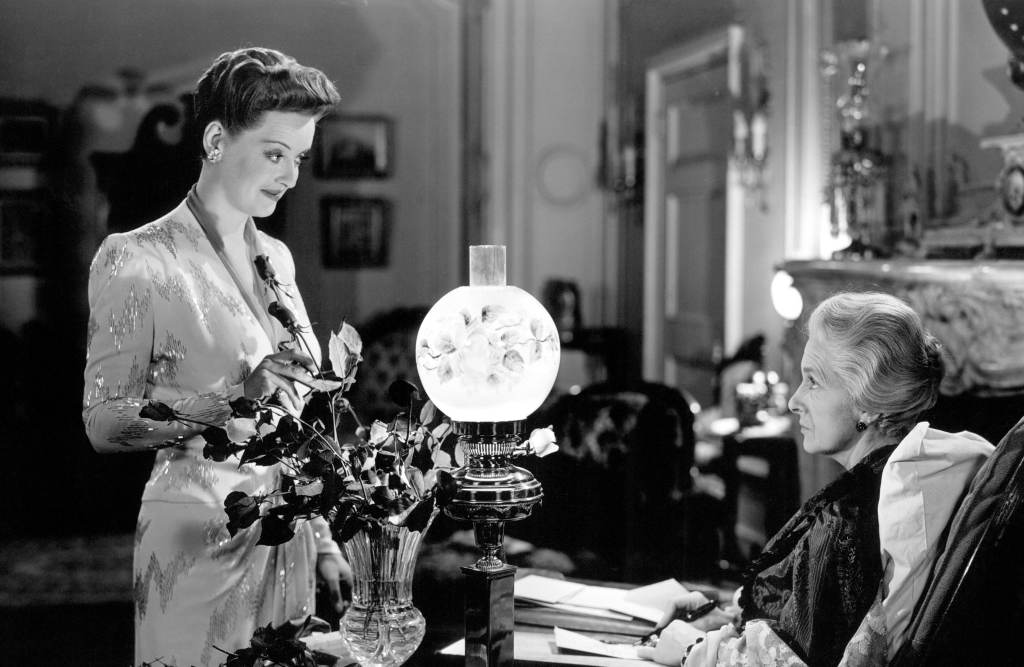
In an essay for Criterion titled ‘Mother Monster,’ the academic and writer Ella Taylor states, “Now, Voyager’s real badass mom, and not in a good way, is a snobby Boston Brahmin played with quietly rabid conviction by British actress Gladys Cooper. Mrs. Henry Vale is a prime example of how melodrama of the period rendered the horrid mothers in classic fairy tales—the witch, the wicked stepmother, the predatory crone.” And in Now, Voyager, we have arguably the doyen of bad mothers.
Now, Voyager was one of the biggest hits of the maternal melodramas Hollywood made during World War II, as studios sought to spotlight mothers as cinematic role models for women at a time when some were war widows raising children alone, some were embarking on extramarital trysts in the absence of their own partners, while others were basking in their newfound independence as they stepped into workplace jobs previously done by men. Directed by Irving Rapper and based on a 1941 novel by Olive Higgins Prouty, Now, Voyager stars Bette Davis as Charlotte Vale, a middle-aged “frump” whose is under the thumb and command of her overbearing mother. Mrs Vale describes Charlotte, who she had given birth to during her forties, as “a child of my old age.” At one point she says, “of course it’s true that all late children are marked. Often such children aren’t wanted. That can mark them. I’ve kept her close by me always. When she was young, foolish, I made decisions for her. Always the right decisions.”
Charlotte’s sister-in-law, who fears Mrs Vale is driving Charlotte towards a mental breakdown, introduces Charlotte to the protective, kind, and liberal psychiatrist Dr. Jaquith (Claude Rains), who observes Mrs Vale’s control over her daughter’s life and recommends Charlotte spends some time away in his sanatorium. “My dear Mrs Vale,” Jaquith says as he smoothly confronts her, “if you had deliberately and maliciously planned to destroy your daughter’s life, you couldn’t have done it more completely.”
After discharge and reluctant to return home, Charlotte embarks on a literal journey of discovery in the form of a life-changing cruise, where – away from her mother – she blossoms into the picture of chic independent woman. Those of you who have seen the film before will be aware of the famous tracking shot of Davis on her return. She is a woman transformed by liberation, and the reveal of Charlotte’s new appearance – where she emerges looking very much like Bette Davis the movie star, and with a newfound sense of personal assuredness. When asked by Mrs Vale what she plans to do with her life on her return home, Charlotte irks her traditional mother by saying she will “get a cat and a parrot and live alone in single blessedness.” But Charlotte’s independence also brings the most human of hardships, a complicated love affair in the form of desire for an unhappily married father Jerry (Paul Henried), and — through a twist of fate, a chance meeting an encounter Jerry’s young daughter, Tina, with who Charlotte forms a significant bond, taking on the role of a compassionate and sympathetic surrogate mother to the troubled girl with mother issues of her own.
Of course, Mrs Henry Vale would not be such a menacing and formidable screen presence without the talent, diction, and sternness Academy Award Winner Gladys Cooper brings to the role. British born Dame Gladys Constance Cooper, DBE, had an illustrious career spanning seven decades, starting out as a teenager in Edwardian musical comedy and pantomime, before moving to dramatic roles and silent films before the First World War. Between 1917 and 1934, Cooper managed the Playhouse Theatre – where she also starred in various roles – and from the early 1920s won praise playing the lead in productions by W. Somerset Maugham and Noel Coward (amongst others) on the London stage. Cooper turned to cinema full-time in 1940, where she found Hollywood success cast in roles as aristocratic and disapproving society woman (although, granted, did was offered opportunities to play more personable, approachable women, as she did opposite Laurence Olivier’s Maxim de Winter in Rebecca (1940). Coopers various cinematic mothers, which pinnacled in Now, Voyager, also include a socialite mother in Kitty Foyle (1940), Laurence Olivier’s spurned wife in That Hamilton Woman (1941), Deborah Kerr’s tormentor mater in Delbert Mann’s Separate Tables (1958).
Yet, for all its success, Now, Voyager is both ambivalent towards motherhood, and in general mothers did not fare well at the pictures during this time, as cinemagoers preferred other variations of womanhood on screen. Ironically Davis would herself portray an overbearing mother in The Little Foxes and a mother surrogate of sorts All About Eve, as the star who takes the fame hungry newcomer under her wing only to be dethroned. Taylor notes that you can tell Davis was all-too aware and not entirely convinced by the characterisation of Charlotte, Davis as “rather too cool and aloof a cat to entirely persuade as a woman who ends up wanting self-sacrificing motherhood even more than she desires a passionate liaison.”
In Now, Voyager, we take pleasure in seeing Charlotte gain autonomy over the film. Still, in our gratification, we may also wonder about the events that lead to Mrs Vale’s nastiness and ponder what, or who exactly, in Taylor’s words, “mistreated the monster.”
 Sabina Stent