Film Intro: “Grey Gardens” [MAC Birmingham 20/07/2024]

In 1972, Lee Radziwill—the younger sister of Jackie Bouvier Kennedy Onassis—pitched a documentary about her East Hampton childhood home to the American documentary makers and siblings Albert and David Maysles. She took the brothers with her on a trip to Grey Gardens, a mansion designed in 1897 by Joseph Greenleaf Thorpe and so-called because of the colour of the dunes, the concrete garden walls, and the sea mist. In Grey Gardens, her aunt and cousin lived.

The Beale women, mother and daughter, both named Edith Bouvier Beale—or “Big Edie” and “Little Edie”—were once members of New York City’s high society, but a series of circumstances saw them withdraw from city life and live a more isolated existence together for over fifty years at Grey Gardens, which had devolved into a complete state of disrepair. Their lives in this crumbling house, surviving on limited funds and living in increasing poverty, were at odds with the glamour of the Kennedy dynasty and the affluence of the Hamptons, which has a historic reputation as home to the wealthy and summer playground to the rich. The Beales lived in such appalling living conditions—flea infestations, cats co-habiting with raccoons, no running water, and surrounded by rubbish and rot—that following an inspection by the local health department (which the Beales referred to as “raids”), Grey Gardens featured in such contrasting publications as tabloid rag the National Enquirer *and* as a New York Magazine cover story. In 1972, with eviction and the City threatening to demolish Grey Gardens, Jackie O and Radziwill provided the necessary funds to stabilize and repair the dilapidated house, hoping it would meet village codes.

Big Edie—a former socialite and singer—and her estranged lawyer/financier husband, Phelan Beale, has purchased Grey Gardens in the early 1920s. The couple separated in 1931 and were legally divorced in 1946, with Phelan notifying his wife of the divorce via telegram. Big Edie was given Grey Gardens plus child support for their daughter and two sons (but no alimony), so relied on financial support from her family and continued to give local recitals, which did not pay exceptionally well. During the late 1940s, when Big Edie’s health started to decline, Little Edie—by now a thirty-something former debutante who had spent five years unsuccessfully pursuing an acting career in Manhattan—left her life to live permanently at Grey Gardens. A dutiful daughter bound to her now ailing mother. Her brothers, obviously, had no such obligations.

The Maysles immediately expressed interest in these women–their past and present lives and Grey Gardens—and received permission to film a documentary about the Beales. While Radziwill funded what has since become known as the first, shelved, lost version of the film in 1972, the brothers returned to Grey Gardens in 1974 without Radziwill’s financial support. In 1976, Grey Gardens was released to great acclaim and screened at that year’s Cannes Film Festival (but not entered into the main competition).

Given the subject matter and the squalor the Beales lived in, ethical issues continue to circumnavigate the film, including the exploitation of what many consider to be two mentally ill women. When asked about this in a 2014 interview with the Hollywood Reporter, Albert Maysles responded so:

“As someone with a background in psychology, I knew better than to claim [the Beales] were mentally ill. Their behavior [sic] was just their way of asserting themselves. And what could be a better way to assert themselves than a film about them asserting themselves? Nothing more, nothing less. It’s just them. They were always in control.”

For the women, financial issues were also in play. In 2018, The Telegraph reported that “[The Beales’] reasoning for allowing the cameras in was also practical: they were in dire need of money.” The Beales were compensated for their cooperation—how much is up for debate—yet it’s a vicious cycle because some documentarians believe that paying subjects for their time skewers how they portray themselves and hinders their authenticity on screen.

Grey Gardens leaves you debating whether Big Edie guilt-tripped her daughter into coming home to live with her mother or whether Little Edie was given no choice but to return home out of social obligation. If you read between the lines, you can see a mother who believes her children ruined her singing career and a daughter who was coerced back home and prevented the opportunity to live a rich, independent life of her own. They clearly love one another, but their lives are filled with nostalgia, regret, lost opportunities, and “what could have beens.” Their daily arguments are fierce and constant—conversations become explosive before simmering down again, bubbling away until the next one. In one tense exchange, Little Edie says, “I suppose I won’t get out of here until she dies or I die. I don’t like it. I like freedom.” “Well,” her mother responds, “you can’t have it.”

These themes were explored in the 2009 film Grey Gardens, which starred Jessica Lange as Big Edie and Drew Barrymore as Little Edie and was broadcast on HBO. The non-linear film flashes back and forth over the years between Little Edie’s life as a young debutante in 1936, moving in and co-habiting with her mother at Grey Gardens estate, and the filming and premiere of the documentary. This version of Grey Gardens won six Primetime Emmys and two Golden Globes.

In 2010, Grey Gardens was selected by the Library of Congress for preservation in the United States National Film Registry as being “culturally, historically, or aesthetically significant.” In 2012, the documentary topped the list of 100 greatest documentary films of all time by PBS through public voting, and in 2014, a Sight and Sound poll of film critics voted Grey Gardens the tenth-best documentary film of all time. The Beales and the film continue to be referenced in various media.

Big Edie died of pneumonia at Southampton Hospital in Southampton, New York, on 5 February 1977. In 1979, following her mother’s death, Little Edie sold Grey Gardens—on the condition the mansion would not be razored—to Sally Quinn and her husband, longtime Washington Post editor Ben Bradlee, who restored the house and grounds, living at Grey Gardens for 35 years until Bradlee died in 2014. In 2017, after renting out the property, Quinn sold Grey Gardens to fashion designer Liz Lange and her husband, who extensively remodelled the house and surrounding gardens. Like the film that made it famous, Grey Gardens continues to survive.

Little Edie died in Florida in January 2002 at the age of 84. Before Big Edie passed away, Little Edie is said to have asked if her mother had any final words. “There’s nothing more to say,” Big Edie replied. “It’s all in the film.”
Film Intro: “The Idiots” [MAC Birmingham 10/09/23]

Lars von Trier’s 1998 pitch-black comedy-drama The Idiots, I won’t deny, is a tricky one to introduce and probably the most volatile of LvT’s films. It was the first to be made in total accordance with the Dogme 95 Manifesto (as established in previous weeks, Breaking the Waves was the first film he completed following the manifesto’s conception). The Idiots, often called Dogme # 2, is also the second in LvT’s Golden Heart Trilogy, succeeding Breaking the Waves and preceding Dancer in the Dark.

While Luis Buñuel’s 1972 Discreet Charm of the Bourgeois was about disrupting a well-to-do couple’s lavish dinner party in Surrealist style, it was funny rather than offensive. In Kristoffer Borgli’s 2022 film Sick of Myself,  a young woman called Signe (played brilliantly by Kristine Kujath Thorp) starts taking illegal drugs to make herself ill in a quest for celebrity. Sick of Myself was often rip-roaringly funny for showcasing the inherent narcissism prevalent in the social media age, and while it was called shallow in parts, human beings are frequently shallow people who thrive on attention, which made Signe’s narcissist devices to gain fame so funny. We could say that The Idiots paved the way for such a nihilistic satire, albeit in a very confrontational, controversial, and extreme way.

In every Lars von Trier film, he asks us to confront something deeply uncomfortable about the human condition: in Antichrist, it is grief and violence. In Breaking the Waves, the limits of faith and love. While it is impossible to shy away from The Idiots’ incredibly provocative and offensive subject matter and brazen bad taste, von Trier’s iconoclasm and taboo-shattering work still exposes sociological behaviour codes, ideas of normalcy, and conditioned emotional responses.

As divisive now as when it was released in 1998, The Idiots was nominated for a prestigious Palme d’Or at the Cannes Film Festival AND booed and criticised for its subject matter. In brief terms, the film is about a group of able-bodied people who, in seeking their ‘Inner Idiots,’ take on attributes of disabled people in public. 

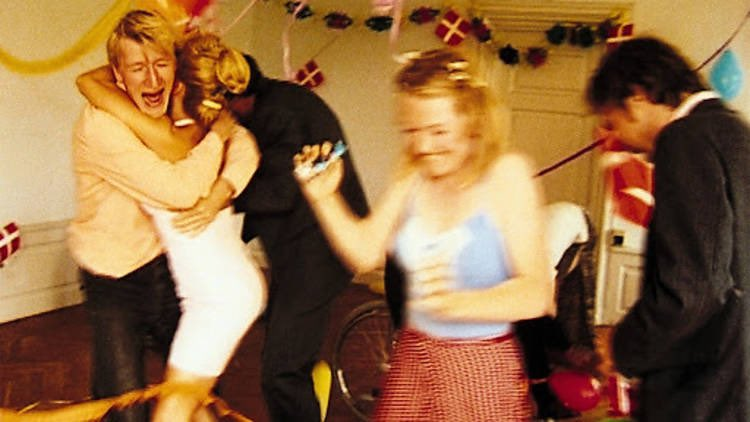
Filmed in four days and with a largely non-narrative and improved script, the film begins with Karen (Bodil Jørgensen), a polite, shy, quiet, severely unhappy woman – with a delicacy not unlike Emily Watson as Bess in Breaking the Waves – who is eating lunch in a restaurant alongside a group of disabled adults. While the other diners look on, aghast at their behaviour, Karen’s kindness and curiosity lead one of the group, Stoffer (Jens Albinus), to take a shine to her. Karen, who, through her own desires and actions – they don’t force her – goes back to their residence, where she learns the truth: this is all an act, Stoffer is house-sitting for his rich Uncle while the house is on the market, and the group take turns to (disgracefully) act out various forms of disability in public to, as they claim, free themselves from the trappings of their day to day lives. 

Stoffer is cultish in his self-appointed leadership role, and while the others leave their inner Idiot at the commune’s door, Stoffer believes they should take it home to their families and let it into their personal lives. This is one example where the group is not as unified as first thought, and one of the ways they start to splinter as a unit. Another occurs when a commune member invites a group of individuals with Down’s syndrome to tea at the house. Stoffer storms off while the others display genuine tenderness, compassion, and kindness towards these strangers. At that moment, it appears Stoffer has become one of the very individuals in the restaurant he was attempting to rail against. 

The film does have one of two genuinely funny moments not hinged on their unacceptable behaviour. When the group visits a factory, and the foreman gets Stoffer to drive the van home, it’s funny because seeing someone drive a vehicle non-fatally into bushes is always funny. There are also jaw-dropping moments of graphic nudity and sex. But at the same time, putting these moments of hilarity into a film such as this implies von Trier is pointing to the audience by saying, “Yes, these people are deplorable, their actions are abhorrent, yet you are still finding moments of humour.” 

But underneath it all, there is a tragedy, as many of these people have been broken by various situations in their personal lives and found freedom and community in this group of people’s unacceptable actions. Karen’s is by far the most interesting story – a broken woman in a deep pit of grief who has found the family and affection she craves and a form of therapy through the group. This culminates in a powerful final scene after Karen returns to the home she originally fled, revealing both the grief that sent her running, and the healing she achieved in this community.

Liner Notes: “Sick of Myself” [Blu-Ray: Vinegar Syndrome/OCN, 2023]

“No one has free will. No one wants to be a psychopath. No one wants to have destructive urges.”

In her brilliant 2022 short story collection titled ‘Bad Thoughts’, writer Nada Alic explores contemporary women’s irreverent and surreal internal thoughts and fantasies. Alic’s stories, which indicate and express the often feral proclivities and inner monologues experienced by many individuals, are written with acute agitation and each story makes perfect and hilarious sense. ‘There are things in your life that you’re like, “I want to hear that other people have thought this terrible thing, so I feel less bad,” Alic told Sophia June in an interview with NYLON magazine.

Saying ‘the bad thoughts out loud’ is conventionally unexpected and, as the success of Alic’s book demonstrates, relatable. Part of the reason television shows like Seinfeld endure is because the characters have no compunctions about niceness, doing what is right, or saying the right thing. Alic’s book resonated with so many because we all have these so-called ‘bad thoughts’ that usually remain hidden as unhinged internal monologues, like dirty little personal secrets. Whether we translate these thoughts into actions in a bid for attention and infamy is another matter entirely. 

This is the pitch-black heart of Norwegian writer/director Kristoffer Borgli’s hilarious Sick of Myself, a wickedly dark riff on society’s obsession with celebrity, Munchausen’s, cancel culture, and the extreme narcissism of the social media age. In an interview with Wendy Ide for Screen Daily, Borgli said he was writing the film “more based on my own taste, and that I like these ‘unlikeable’ characters. Characters that break all moral norms and break all the boundaries that you’re not allowed to in real life. It’s a thrill to watch that type of character in cinema, or fiction in general. It’s a way to exorcise some demons.” His film is the flip side of 2021’s The Worst Person in the World, the award-winning third and final part of Joaquim Trier’s Oslo Trilogy, where the film’s protagonist Julie (‎Renate Reinsve) worried about being perceived as a terrible person. In Sick of Myself, Signe is the embodiment of Julie’s fear.

Signe (Kristine Kujath Thorp) is a compulsive liar and self-absorbed young woman who thrives on attention. Every conversation must be about her or something that has happened to her. Anecdotes may be rooted in the mundane but always heightened for extremity, excitement, and emphasis, such as telling people she has six toes or feigning a fatal nut allergy at a dinner party. While some films or directors would allow their audience to discover this character defect over the course of the film, Borgli presents Signe’s performative narcissism from the very first scene.

The film opens with Signe and her kleptomaniac boyfriend Thomas (Eirik Sæther) in a restaurant. As self-absorbed as she, with an equally inflated sense of self-worth, Thomas — a conceptual artist whose gallery installations consist of chairs he has stolen from furniture stores — orders an expensive bottle of wine, which he plans to steal by legging it out of the restaurant. Signe agrees to the plan, but only if they tell their friends she’s the thief. Their wine heist is further interrupted when a Birthday cake arrives for Signe, and Thomas complains she has drawn unnecessary attention to herself. However, all attention is desirable to her, including the eyes of the waiter who ignores her smoking on the street as he chases Thomas in pursuit of payment. Oblivious to her presence, she is incredulous and astounded at her invisibility.

Signe and Thomas’ entire relationship is a never-ending quest for centre stage as they relay their anecdotes to friends and whomever will listen with an inflated sense of grandeur and self-worth. It’s an inherently toxic dynamic, and they would be nightmares to be around, yet they are ideally suited. They are made for each other, but you can’t help but think they will eventually destroy one another and themselves in the process.

When Thomas’ art career takes off, Signe is desperate to regain the spotlight and place some attention back on herself. Scrolling Twitter, she sees an article on the Daily Mail’s news feed about Lidexol, a Russian drug banned due to causing a severe and extremely rare skin disease. Rather than shock or sympathy, she sees an opportunity. Ordering bulk quantities of Lidexol through her dealer Stian (Steinar Klouman Hallert), Signe takes vast amounts of Lidexol to make herself sick and garner attention. After days of taking the drug with no side effects besides drowsiness and occasional narcolepsy, a rash materialises on Signe’s arm and neck, and a moment of joy flashes on her face. That night in bed, she positions herself in such a way that Thomas is sure to notice but is disappointed when he encourages her to see a doctor. During the examination, she refuses to remove her jacket because a diagnosis and cure are not part of her plan. 

As Signe ingests even more Lidexol and becomes increasingly disfigured, the film verges from acerbic rom-com to subversive body horror, and her disfigurement becomes so extreme she is hospitalised and issued a mask reminiscent of the one worn by Édith Scob in Georges Franju’s Eyes Without a Face (1960). Yet she relishes her inconvenience, basks in her wrongness, taking selfies and posing like an Instagram influencer in front of the hospital’s mirrors. The incredible image of Signe sitting in a wheelchair with her bandaged face and gown, smoking a cigarette and wearing sunglasses while scrolling her phone in the sunshine is idiosyncratic, enduring, and extremely funny. 

These visuals are part of the film’s joy, each so sharp and often rapid. Thorp’s performance has a subtle physicality, whether rolling tablets into her mouth, falling asleep pouring coffee, or spontaneously throwing her laptop out the window to stop Thomas from glancing at what he believes to be porn on her screen. The film frequently veers into fantasy, one highlight being a brilliant scene when a doctor (played by real-life M.D. and star of The Worst Person in the World Anders Danielson Lie in a cameo that further heightens the connection between both films) arrives to tell Signe the results of her CT scan: that she has abused illegal drugs, lies a lot, is not the coolest person at parties, and that she has a bad and sometimes racist sense of humour (“I haven’t seen that for quite some time.”) Calmy, he reveals that so much is wrong with her personality that the police have been called and are waiting outside, ready to execute her. 

Going home from the hospital, Signe is annoyed to find only 56 messages on her phone. She immediately complains about the lack of visitors, saying the friends who didn’t take the time to visit are not welcome at her funeral. The ‘funeral guest list’ becomes the set-up to an incredible sex scene where the eroticism revolves around every individual’s final public appearance, albeit one they will never see for themselves. Pondering who will attend your funeral is a narcissist’s fantasy, and Signe takes it to the extreme. “Ask me again how I’m doing,” she urges Thomas, becoming increasingly turned-on, before breathily asking him to describe her funeral in minute detail. As he regales her with the specifics of his grief, the ‘guest list,’ and the line out of the church, arousal increases, and she climaxes on hearing how her father was refused from the service because he was not on the guest list. The French term for orgasm is ‘la petite mort’ or ‘the little death’ because the sensation is likened to death, and each one brings us closer to the inevitable. For Signe, it is death — significantly, her death — that brings her to orgasm.

In sickness, Signe has the attention she seeks. However, it is not enough. As Thomas’ success increases, her compulsive tendencies go into overdrive, and she takes further action. When Thomas gives a magazine interview about his art, she pushes to be interviewed about her illness and is appeased, albeit briefly, when her story is published. Yet nothing is permanent in news, fame can be fleeting, and her health ordeal is soon redundant when breaking news of a gunman shooting his family dominates the website’s homepage. Deluded by thinking she is more important than this tragedy, Signe calls her journalist friend Marte (Fanny Vaager) asking if her interview can be bumped back to the top of the page. Incredulous it can’t, she shouts, “what fucking nerd shoots his whole family?” in exasperation.

Thorp is superb as Signe, a woman so self-involved she has intense issues with genuine tragedy or trauma but cannot see why her faking it is so problematic and wrong. Her actions are often questionable, despicable, and inappropriate, and she is indeed a terrible person, but utterly compelling to watch, largely because of Thorp’s performance. Occasionally she allows rare flashes of sadness to cross Signe’s face, and there are moments towards the end of the film when we may find ourselves feeling modicums of sympathy as she displays hints of being sick of herself.

In this story of self-sabotage and social wrongs are some very astute comments about public perception and the nature of performance. The film riffs on this well, especially the divide between how we present ourselves in public and who we are personally, such as the agent who signs Signe to her “inclusive” modelling agency, virtual signalling in the name of public image, but not wanting to be held legally responsible for any of her client’s health troubles.

Early in the film, a woman stumbles into the café where Signe works after being severely bitten in a dog attack. Two weeks later, she is still talking about the ordeal, not out of sympathy for the woman bleeding, but to boast how she helped and the trauma she (not the victim) experienced. After the incident, Signe walked home in a blood-soaked shirt, and the other woman’s blood unwiped from her face so that passersby stare and ask if she’s ok. But at the end of the film, Signe is the one in need of help. Her condition has worsened to the extreme, and she is the helpless one in desperate need of attention not out of vanity, but of need. Yet the room is more concerned by those fainting in reaction to her deterioration, or the ones screaming that they can’t be held accountable for the situation. Once the storyteller, Signe has now become the story of someone else’s attention-seeking narrative.

Towards the end of the film, Signe fantasises about writing a best-selling book of her experiences and becoming a celebrity capitalising on her ordeal. It’s not that far-fetched when you think about it. It is also her most self-aware moment in the film. Unlike its protagonist, Sick of Myself is a cognizant film; Signe embodies the trappings of modern culture in a way that some may consider distasteful, yet merely reflects the society we live. Through her, Borgli presents what many entertain but would never (especially publicly) say or do. Watching nihilistic behaviour by terrible people or putting socially relatable bad thoughts into play may be deemed wrong, naughty, or repellent, but when done right it’s hilarious, thrilling, and wickedly good.

*This essay was written for the booklet of Vinegar Syndrome/OCN’s 2023 release of ‘Sick of Myself’, available to buy here: https://vinegarsyndrome.com/products/sick-of-myself

Film Intro: “Antichrist” [MAC Birmingham 09/09/23]

In 2006, Lars von Trier was hospitalised for depression and started writing Antichrist, the first film in what would become known as his “Depression Trilogy.” (Melancholia followed in 2011, and Nymphomaniac in 2013). 

Filmed in 40 days on a 4K digital camera, Antichrist was the first of LvT’s films to be shot entirely in Germany and was heavily influenced by horror – the director had watched the Japanese horror films Ring and Dark Water, although he is reluctant to describe Antichrist as a horror film (yet it is often labelled as art horror or psychological horror). At the same time, Von Trier had watched a documentary about European forests which detailed the violence of nature, and how these beautiful places are dark landscapes of pain. For LvT, nature “represents pure Hell,” yet people are still content to hang paintings of it in their homes. 

Antichrist is about a couple, Willem Dafoe and Charlotte Gainsbourg — credited as “He” and “She” — who retreat to the woods, or Eden, after the tragic accidental death of their infant son. The tragedy plays out in a breath-taking prologue, or opening sequence, as the couple are having sex in their home. The powerful black and white scene has no dialogue but is scored to Lascia Ch’io Pianga from Handel’s opera Rinaldo (the translation of Lascia Ch’io Pianga is “let me weep.”) Von Trier would use the aria again in Nymphomaniac (which starred Gainsbourg and featured Dafoe in Vol. 2). 

After “She” collapses at the funeral and spends a month in hospital under the diagnoses of atypical grief, “He” — a therapist with a distrust of psychoanalysis — has his wife discharged from hospital and takes it upon himself to counsel her himself (clearly a bad idea for a greiving father). His course of action is exposure therapy — making her confront her greatest fears to overcome her grief — and seeing as her second greatest fear is nature, they hike to the cabin in the woods where she had spent the previous summer with their son writing her since abandoned thesis. But through this journey of mourning, something wild and sinister is unleashed, and the film powerfully explores themes including sexual violence, sadomasochism, and the untamed wild power of nature.

There is also, obviously, a religious angle, “He” and “She” / Adam and Eve —but whatever your interpretation, it is a film rooted in mourning and despair.

Eva Green had been originally approached for the lead, and despite her determination to do the film, her agents would not permit it. In von Trier’s words, “Charlotte came in and said, ‘I’m dying to get the part no matter what.’ So I think it was a decision she made very early and she stuck to it. We had no problems whatsoever.” Gainsbourg has said she knew little of von Trier before their first meeting, although she knew his films and was highly anxious before they met in person. She was also concerned about the film’s more emotional sequences because LvT’s leads often go to very dark, frequently violent and/or intense places. She was also worried about depicting her character’s panic attacks and anxiety as she had experienced them herself.

Dafoe had previously worked with von Trier in 2005’s Manderlay, and had contacted the director to ask what he was working on around the time Antichrist was in its infancy. Of the role, Dafoe said, “I think the dark stuff, the unspoken stuff is more potent for an actor. It’s the stuff we don’t talk about, so if you have the opportunity to apply yourself to that stuff in a playful, creative way, yes, I’m attracted to it.” 

Antichrist, as is the pattern with LvT’s films, polarised its audience when it premiered at the 2009 Cannes Film Festival — there were walkouts and a handful of fainters. When questioned at the film’s press conference, von Trier commented that he had no need to justify the film because the audience were his guests and “not the other way around,” and claimed to be the best director in the world. The ecumenical jury at the Cannes festival gave the film a special “anti-award,” declaring Antichrist “the most misogynist movie from the self-proclaimed biggest director in the world,” yet Charlotte Gainsbourg still won the festival’s award for Best Actress.

In a tragic line from the film to Gainsbourg’s personal life, her sister, the British fashion photographer Jane Barry, whose work appeared in numerous commercial magazines and newspapers (including Vogue and The Sunday Times Magazine), as well as collaborations with their mother (the late Jane Birkin) and sisters, died as a result of a fall from her fourth-floor apartment in the 16th arrondissement of Paris on 11 December 2013. So here you have a very sad connection to the film. Some of the images and Barry’s death may also remind you of the murder of artist Ana Mendieta.

Antichrist is a viewing experiences that stays with you. Numerous friends and acquaintances say once watched, they don’t need to watch it again for maybe a decade — or ever again — much like Gaspar Noé’s 2002 Irrévervisble (which starred Vincent Cassel and Monica Bellucci). Incidentally, there is another link to Noé, and something we can connect to the witch-hunts mentioned in Antichrist. In 2019, Gainsbourg worked with Noé on his experimental short film Lux Æternal alongside Betty Blue star Béatrice Dalle, both playing fictional versions of themselves (Dalle is directing Gainsbourg in a film in this case). The film begins with a short montage of 1920s-style documentary footage of witch torture, and features Gainsbourg in a witch-burning scene. Lux Æternal concludes with a Luis Buñuel quote which I believe is relevant to Antichrist: “Thank God I’m an Atheist.”

Film Intro: “Breaking the Waves” [MAC Birmingham 01/09/2023]

Breaking The Waves

In 1995, the controversial filmmaker Lars von Trier founded the Dogme 95 filmmaking movement with fellow Danish director Thomas Vinterberg. Dogme 95 was about creating films based on the traditional values of story, acting, and theme while excluding the use of elaborate special effects or technology – essentially a way for filmmakers to reclaim their power from the studios. While Breaking the Waves was the first film von Trier made after Dogme 95 and was inspired by its code, it wasn’t the first made in it’s vision (that title went to 1998’s The Idiots) because sets were built, music was added in post op, and computer graphics were used for the chapters title cards. However Breaking the Waves was shot entirely on Super35mm handheld camera which provides its naturalistic element, and is divided into chapters and an epilogue, with each chapter card filmed with a motionless camera but featuring movement in the panorama. In the original released theatrical cut, the epilogue featured David Bowie’s “Life on Mars,” later replaced by Elton John’s “Your Song” on early home video releases. The more recent Criterion edition restores the Bowie song.

Breaking the Waves was the first of von Trier’s films to feature a female protagonist (his earlier works have been said to “typically feature a disillusioned male idealist brought down by a deceitful woman”), and he would continue to write female leads in subsequent works. Yet von Trier’s female protagonists are often mired in controversy. Bess from Breaking the Waves is one such example.

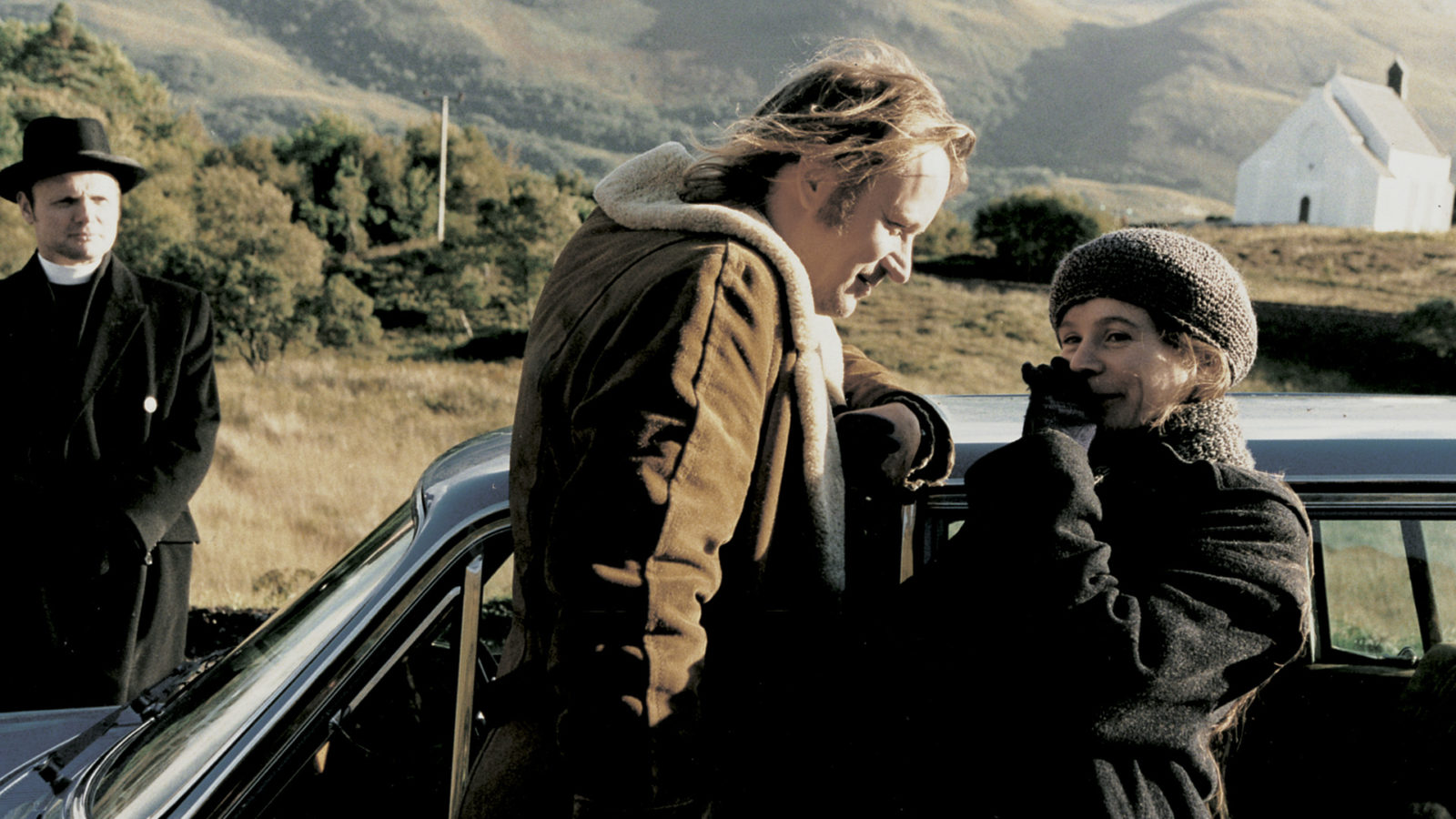
Bess (played by the extraordinary Emily Watson) is a fragile young woman living in a religious and isolated Scottish town who has a history of mental health issues following her brother’s death. A woman of intense faith who converses with God, Bess is very pure, somewhat childlike, and fundamentally a good person – she is even described as being “good” in the film, and sometimes being too good a person has consequences. 

Bess’ image and fragility are why her marriage to Jan (Stellan Skarsgård), a trawler man working on a rig and not originally from the Island, is met with some disapproval from the local community. But Bess is besotted with Jan – he is her sexual awakening, she’s very clingy with him, and she finds it unbearable how his work takes him away from her for long periods of time. She says she “loves him too much.” 

Early in their marriage, and early in the film, Jan becomes paralysed following an accident at work. No longer able to physically satisfy his wife, Jan encourages Bess to sleep with other men and tell him about her adventures. When Bess relents to Jan’s voyeuristic desires, and Jan shows signs of improvement, she starts to believe her husband’s recovery is contingent on her actions. In convincing herself she has the power to heal, Bess essentially martyrs herself out of overwhelming love and devotion to her husband.

Some critics viewed Bess as a self-sacrificing submissive heroine and misogynist cliché, while von Trier’s themes of female sexual perversity, phallocentrism, and martyrdom – which would be continued in subsequent works – were also criticised. Yet what makes Breaking the Waves such an enthrallingly beautiful (and tough in parts, that’s undeniable) viewing experience is due to Watson, who is a force as Bess – an Academy Award nominated force – in what was, stunningly, her feature film debut. Watson is a beautifully physical actor (she does something similar in Anand Tucker’s Hilary and Jackie in her role of Jackie du Pré), and you see Bess’ physicality alter throughout the film depending on who she is with at any given time. Watson was actually expelled from the London College of Philosophy and Economic Science for taking on this role due to its graphic themes and nudity (the very reasons Helena Bonham Carter dropped out of the production), which is ironic given how Bess is ostracised by society in the film.

Huge praise must also be given to the late Katrin Cartlidge as Dorothy or the affectionately nicknamed “Dodo”, who plays Bess’ sister-in-law. A frequent collaborator of Mike Leigh who was due to play Patricia Clarkson’s roll in Dogville, the immensely talented Cartlidge tragically passed away in 2002 at the age of 41 due owing to complications from pneumonia and septicaemia (stemming from a pheochromocytoma). Dodo is Bess’ closest companion, a nurse in the hospital who is caring for Jan, and she is Bess’s pragmatic voice of reason.

Von Trier has often said he is an atheist, and wanted to make a naturalistic film that was also religious – Bess even compares herself to Mary Magdeleine at one point – but for it to be a film without any miracles. Breaking the Waves is often described as magical realism, and there is certainly a fantastical, almost spiritual, element, built-in. Undeniably, there are some gorgeous moments of metaphysical magic. 

Essentially, Breaking the Waves is a beautiful, shattering, film about love, devotion, the power and limits of faith, and the investment of belief to help the people you love.