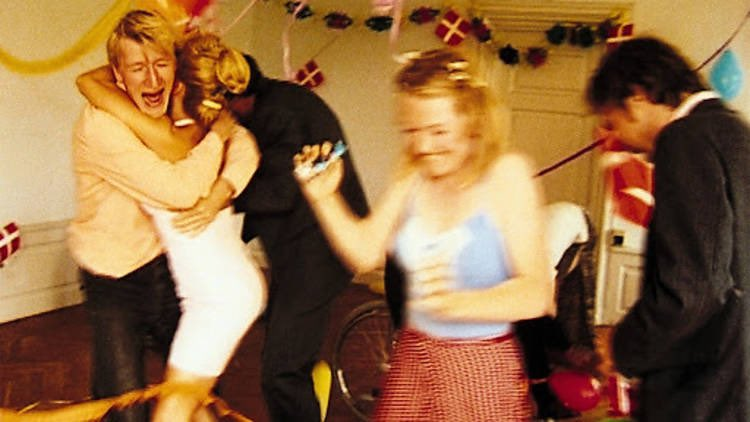
Lars von Trier’s 1998 pitch-black comedy-drama The Idiots, I won’t deny, is a tricky one to introduce and probably the most volatile of LvT’s films. It was the first to be made in total accordance with the Dogme 95 Manifesto (as established in previous weeks, Breaking the Waves was the first film he completed following the manifesto’s conception). The Idiots, often called Dogme # 2, is also the second in LvT’s Golden Heart Trilogy, succeeding Breaking the Waves and preceding Dancer in the Dark.
While Luis Buñuel’s 1972 Discreet Charm of the Bourgeois was about disrupting a well-to-do couple’s lavish dinner party in Surrealist style, it was funny rather than offensive. In Kristoffer Borgli’s 2022 film Sick of Myself, a young woman called Signe (played brilliantly by Kristine Kujath Thorp) starts taking illegal drugs to make herself ill in a quest for celebrity. Sick of Myself was often rip-roaringly funny for showcasing the inherent narcissism prevalent in the social media age, and while it was called shallow in parts, human beings are frequently shallow people who thrive on attention, which made Signe’s narcissist devices to gain fame so funny. We could say that The Idiots paved the way for such a nihilistic satire, albeit in a very confrontational, controversial, and extreme way.
In every Lars von Trier film, he asks us to confront something deeply uncomfortable about the human condition: in Antichrist, it is grief and violence. In Breaking the Waves, the limits of faith and love. While it is impossible to shy away from The Idiots’ incredibly provocative and offensive subject matter and brazen bad taste, von Trier’s iconoclasm and taboo-shattering work still exposes sociological behaviour codes, ideas of normalcy, and conditioned emotional responses.
As divisive now as when it was released in 1998, The Idiots was nominated for a prestigious Palme d’Or at the Cannes Film Festival AND booed and criticised for its subject matter. In brief terms, the film is about a group of able-bodied people who, in seeking their ‘Inner Idiots,’ take on attributes of disabled people in public.
Filmed in four days and with a largely non-narrative and improved script, the film begins with Karen (Bodil Jørgensen), a polite, shy, quiet, severely unhappy woman – with a delicacy not unlike Emily Watson as Bess in Breaking the Waves – who is eating lunch in a restaurant alongside a group of disabled adults. While the other diners look on, aghast at their behaviour, Karen’s kindness and curiosity lead one of the group, Stoffer (Jens Albinus), to take a shine to her. Karen, who, through her own desires and actions – they don’t force her – goes back to their residence, where she learns the truth: this is all an act, Stoffer is house-sitting for his rich Uncle while the house is on the market, and the group take turns to (disgracefully) act out various forms of disability in public to, as they claim, free themselves from the trappings of their day to day lives.
Stoffer is cultish in his self-appointed leadership role, and while the others leave their inner Idiot at the commune’s door, Stoffer believes they should take it home to their families and let it into their personal lives. This is one example where the group is not as unified as first thought, and one of the ways they start to splinter as a unit. Another occurs when a commune member invites a group of individuals with Down’s syndrome to tea at the house. Stoffer storms off while the others display genuine tenderness, compassion, and kindness towards these strangers. At that moment, it appears Stoffer has become one of the very individuals in the restaurant he was attempting to rail against.
The film does have one of two genuinely funny moments not hinged on their unacceptable behaviour. When the group visits a factory, and the foreman gets Stoffer to drive the van home, it’s funny because seeing someone drive a vehicle non-fatally into bushes is always funny. There are also jaw-dropping moments of graphic nudity and sex. But at the same time, putting these moments of hilarity into a film such as this implies von Trier is pointing to the audience by saying, “Yes, these people are deplorable, their actions are abhorrent, yet you are still finding moments of humour.”
But underneath it all, there is a tragedy, as many of these people have been broken by various situations in their personal lives and found freedom and community in this group of people’s unacceptable actions. Karen’s is by far the most interesting story – a broken woman in a deep pit of grief who has found the family and affection she craves and a form of therapy through the group. This culminates in a powerful final scene after Karen returns to the home she originally fled, revealing both the grief that sent her running, and the healing she achieved in this community.
 Sabina Stent