Almost forgot to say I contributed a video essay (my first video essay!) to this release from Vinegar Syndrome/OCN Distro! Pick up a copy here:


Almost forgot to say I contributed a video essay (my first video essay!) to this release from Vinegar Syndrome/OCN Distro! Pick up a copy here:
I wrote a little personal thing about Ozzy Osbourne, who I loved very much, for my newsletter: https://sabinastent.substack.com/p/ozzy


Based on Elfriede Jelinek’s 1983 novel of the same name, Michael Haneke’s The Piano Teacher (2001) stars French force Isabelle Huppert as Erika Kohut. An unmarried thirty-something who teaches piano at the Vienna Music Conservatory, Erika lives with her domineering mother (Annie Girardot), with whom she shares a bed and a codependent relationship.
Erika’s cool professional façade masks a woman besieged by loneliness and repressed sexual desire who satisfies her proclivities in private until she meets Walter (Benoît Magimel), a young engineer she reluctantly takes on as a student. Together, they embark on a relationship built on obsession and destructive infatuation, outlined by a set of rules imposed by Erika. The outcome is an affair that tows the line between freedom and control, desire and assault, power and submission. Hermione Hoby, in a 2010 article for The Observer, describes how this relationship “refracts and reiterates the parallels between the relationships of mother/daughter, teacher/pupil, captor/captive and abaser/abased.”
The Piano Teacher, replete with its themes of masochism, rape, incest, sexual repression, and sexual violence, premiered at the 2001 Cannes Film Festival and immediately received rapturous acclaim, winning the festival’s Grand Prize as well as Best Actor for Benoît Magimel and Best Actress for Isabelle Huppert.
The project arrived at the right time for Haneke, who had yet to receive a breakthrough after moving away from television, despite his Academy Award-nominated feature film debut, The Seventh Continent (1989). He followed this with other critically acclaimed films, including Benny’s Video (1992), Funny Games (1997), and Code Unknown (2000).
The Piano Teacher’s path was somewhat rocky; after numerous failed attempts, including Haneke’s involvement as a screenwriter but not as director, he was eventually asked to direct and agreed to do so on the condition that Huppert would star. Haneke had first wanted Huppert for Funny Games, and after informing her he would not direct The Piano Teacher without her, she read the screenplay and noted the film’s potential. Coincidentally, Huppert had studied piano as a child and quit at the age of fifteen, but resumed playing for the film.
The beauty – if we can call it that – of The Piano Teacher is its stillness and unromanticism; its ability to unsettle and generate tension while showing so little. It’s a tantalising and thought-provoking film. As David Denby of The New Yorker wrote, “Haneke avoids the sensationalism of movie shockers, even high-class shockers like Hitchcock’s “Psycho” and Polanski’s “Repulsion”. There are no expressionist moments in The Piano Teacher—no scenes of longing, no soft-focus dreams or cinematic dreck”.
Hoby, in her article, notes how book is even more unsettling, noting that “Erika and Walter’s relationship – and its catastrophic denouement – is even more powerful and disturbing than in Haneke’s telling.”
In his Criterion essay for the film titled “Breaking the Ice: The Beginning of Desire in The Piano Teacher”, Garth Greenwell writes that “Part of Haneke’s greatness lies in the way his static shots invite contemplation of compositions that have the density of great paintings. The more you look, the more you find to see. Here the composition is starkly geometrical, a lattice of vertical and horizontal lines. The image is inelegantly, even brutally cropped, the screen divided into four unequal vertical panels, two of them opaque: dull metal that occupies a quarter of the screen, more or less, and obscures our view of the scene beyond.”
Haneke is a master of off-screen tension (Caché, 2005, being another fine example), setting a scene coolly and letting us take our minds to those off-camera places, or the edge of the screen spaces. Even if we don’t want to go there, we find ourselves enraptured, unable to look away. One reason – the main reason – we cannot look away from The Piano Teacher is due to the extraordinary Huppert, who straddles the line between victim and perpetrator, portraying Erika as both repressed and seething, her ice queen exterior masking a torrent of stormy emotion, and described by Mick LaSalle of the San Francisco Chronicle as “a rich incarnation of a woman we might see on the street and never guess that she contains fires, earthquakes and infernos.” Both tightly wound and unleashed as Erika, if you’ve seen Huppert in Paul Verhoeven’s 2016 film Elle, you’ll see how this was very much a precursor to that performance and character.
Peter Bradshaw of The Guardian writes that “this [The Piano Teacher] is the performance that Huppert hints at in the Chabrol movie Merci Pour le Chocolat: cold, malign and profoundly disturbed. Her face, innocent of make-up and adorned only by freckles, often looks like that of a strange 12-year-old living in her own private world. Close-ups look like the very last frame in Polanski’s Repulsion: a freaky vision of a mad, murderous little girl. Huppert rarely allows expression other than, say, a wince of fastidious disgust at some error of musical interpretation or keyboard address. In fact the only real expression comes at the very end: an extraordinary grimace of wrenching pain and self-loathing.”
Denby concludes that The Piano Teacher “is a seriously scandalous work, beautifully made, and it deserves a sizable audience that might argue over it, appreciate it—even hate it.”
Whether you love it or hate it, you certainly won’t forget it.
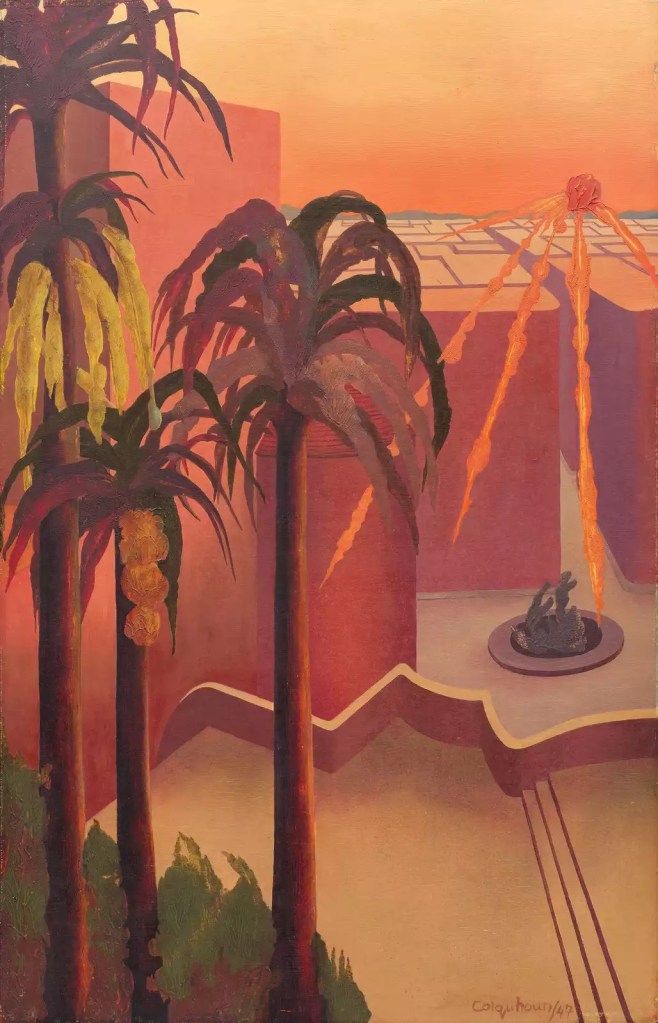
I wrote a heatwave appropriate dispatch on Ithell Colquhoun: https://open.substack.com/pub/sabinastent/p/solstice?r=ceu&utm_medium=ios

A small post about Leonor Fini for my paying newsletter subscribers: https://open.substack.com/pub/sabinastent/p/the-cardinals-stockings?r=ceu&utm_medium=ios

I wrote about Remedios Varo for my newsletter: https://open.substack.com/pub/sabinastent/p/vampiros-vegetarianos?r=ceu&utm_medium=ios

In other news, I am thrilled to appear on the pilot episode of “Branched Out” – possibly “the world’s first ever podcast to unearth the deep-rooted interconnections between multicultural and LGBTQ-inclusive stories and trees” – speaking about Frida Kahlo’s “Tree of Hope” (which I wrote about a couple of months ago on my Substack). Available on all your favourite podcast providers!

