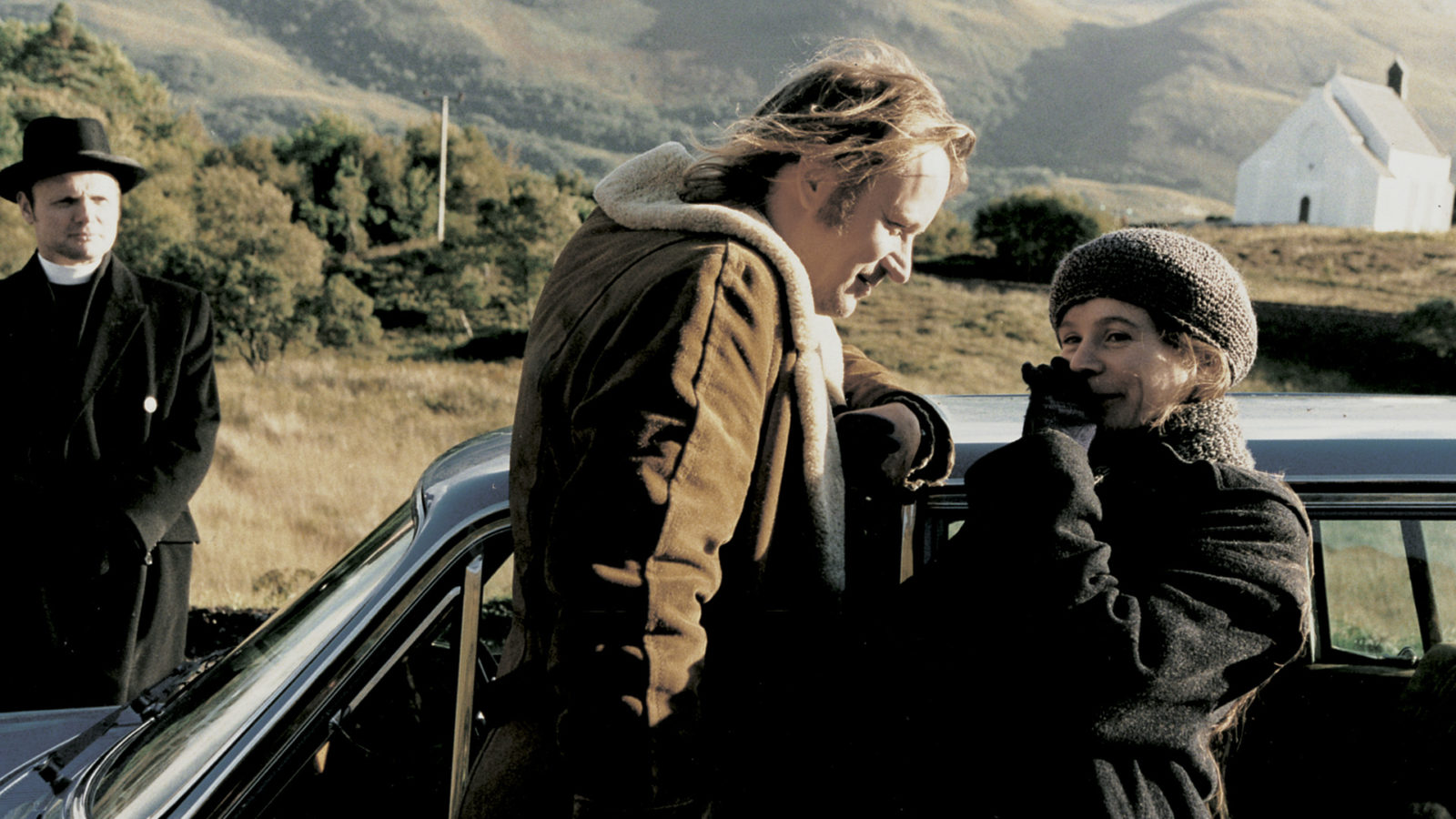
In 1995, the controversial filmmaker Lars von Trier founded the Dogme 95 filmmaking movement with fellow Danish director Thomas Vinterberg. Dogme 95 was about creating films based on the traditional values of story, acting, and theme while excluding the use of elaborate special effects or technology – essentially a way for filmmakers to reclaim their power from the studios. While Breaking the Waves was the first film von Trier made after Dogme 95 and was inspired by its code, it wasn’t the first made in it’s vision (that title went to 1998’s The Idiots) because sets were built, music was added in post op, and computer graphics were used for the chapters title cards. However Breaking the Waves was shot entirely on Super35mm handheld camera which provides its naturalistic element, and is divided into chapters and an epilogue, with each chapter card filmed with a motionless camera but featuring movement in the panorama. In the original released theatrical cut, the epilogue featured David Bowie’s “Life on Mars,” later replaced by Elton John’s “Your Song” on early home video releases. The more recent Criterion edition restores the Bowie song.
Breaking the Waves was the first of von Trier’s films to feature a female protagonist (his earlier works have been said to “typically feature a disillusioned male idealist brought down by a deceitful woman”), and he would continue to write female leads in subsequent works. Yet von Trier’s female protagonists are often mired in controversy. Bess from Breaking the Waves is one such example.
Bess (played by the extraordinary Emily Watson) is a fragile young woman living in a religious and isolated Scottish town who has a history of mental health issues following her brother’s death. A woman of intense faith who converses with God, Bess is very pure, somewhat childlike, and fundamentally a good person – she is even described as being “good” in the film, and sometimes being too good a person has consequences.
Bess’ image and fragility are why her marriage to Jan (Stellan Skarsgård), a trawler man working on a rig and not originally from the Island, is met with some disapproval from the local community. But Bess is besotted with Jan – he is her sexual awakening, she’s very clingy with him, and she finds it unbearable how his work takes him away from her for long periods of time. She says she “loves him too much.”
Early in their marriage, and early in the film, Jan becomes paralysed following an accident at work. No longer able to physically satisfy his wife, Jan encourages Bess to sleep with other men and tell him about her adventures. When Bess relents to Jan’s voyeuristic desires, and Jan shows signs of improvement, she starts to believe her husband’s recovery is contingent on her actions. In convincing herself she has the power to heal, Bess essentially martyrs herself out of overwhelming love and devotion to her husband.
Some critics viewed Bess as a self-sacrificing submissive heroine and misogynist cliché, while von Trier’s themes of female sexual perversity, phallocentrism, and martyrdom – which would be continued in subsequent works – were also criticised. Yet what makes Breaking the Waves such an enthrallingly beautiful (and tough in parts, that’s undeniable) viewing experience is due to Watson, who is a force as Bess – an Academy Award nominated force – in what was, stunningly, her feature film debut. Watson is a beautifully physical actor (she does something similar in Anand Tucker’s Hilary and Jackie in her role of Jackie du Pré), and you see Bess’ physicality alter throughout the film depending on who she is with at any given time. Watson was actually expelled from the London College of Philosophy and Economic Science for taking on this role due to its graphic themes and nudity (the very reasons Helena Bonham Carter dropped out of the production), which is ironic given how Bess is ostracised by society in the film.
Huge praise must also be given to the late Katrin Cartlidge as Dorothy or the affectionately nicknamed “Dodo”, who plays Bess’ sister-in-law. A frequent collaborator of Mike Leigh who was due to play Patricia Clarkson’s roll in Dogville, the immensely talented Cartlidge tragically passed away in 2002 at the age of 41 due owing to complications from pneumonia and septicaemia (stemming from a pheochromocytoma). Dodo is Bess’ closest companion, a nurse in the hospital who is caring for Jan, and she is Bess’s pragmatic voice of reason.
Von Trier has often said he is an atheist, and wanted to make a naturalistic film that was also religious – Bess even compares herself to Mary Magdeleine at one point – but for it to be a film without any miracles. Breaking the Waves is often described as magical realism, and there is certainly a fantastical, almost spiritual, element, built-in. Undeniably, there are some gorgeous moments of metaphysical magic.
Essentially, Breaking the Waves is a beautiful, shattering, film about love, devotion, the power and limits of faith, and the investment of belief to help the people you love.

 Sabina Stent