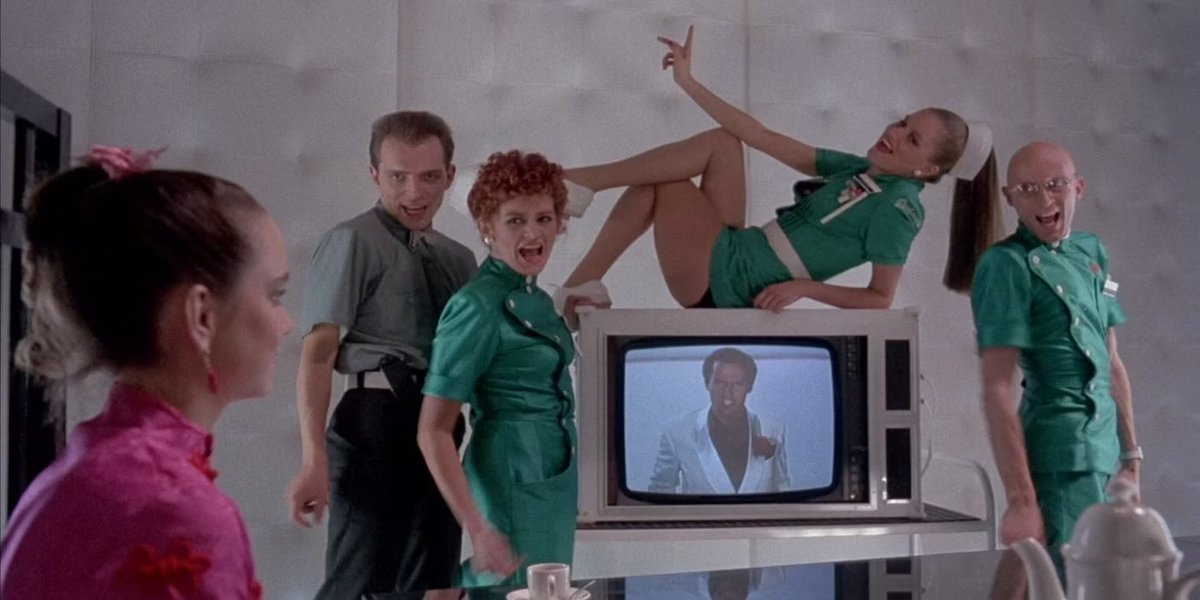
Directed by Jim Sharman, and with a script and lyrics by Richard O’Brien, Shock Treatment is 1981’s non-canon parallel film to the events of 1975’s immensely popular The Rocky Horror Picture Show born of two scrapped productions: Rocky Horror Shows His Heels and The Brad and Janet Show.
Following the unexpected and overwhelming success of Rocky Horror, especially on the midnight film circuit, Richard O’Brien approached producer Michael White with the idea of filming a sequel. In 1978, O’Brien started working on a script. Titled Rocky Horror Shows His Heels, it featured a resurrected Frank and Rocky, Brad and Dr. Scott now lovers, and Janet pregnant with Frank’s baby. However, Sharman was reluctant to revisit the material, and Tim Curry had no desire to reprise his scene-stealing turn of Dr Frank ‘N Furter. Yet because O’Brien had put considerable time and work into the songs, he retained the musical content and reworked the film’s premise.
The second script was titled The Brad and Janet Show—which was closer to what became Shock Treatment—but was plagued by problems during preproduction. Dr. Scott was included in this script version, but once again, reconvening the original cast proved problematic, with Jonathan Adams refusing to reprise his role as the Narrator. Then, in 1980, a problem arose that we have been familiar with in recent years: filmmakers intended to shoot on location in Denton, Texas, but the Screen Actors Guild went on strike, so all production ground to a halt.
However, the strikes revealed a silver lining: with cast and crew availability reduced, the filmmakers had to get creative with their resources. Television already featured heavily in the script, so production designer Brian Thomson had the idea to rework the story and set it in a giant TV studio. Utilising a film studio in the UK cut $1 million from the budget and gave the filmmakers a smaller, more controlled environment. In the final version of the script, all locations were changed to television shows, and the role of Dr. Scott evolved into game show host Bert Schnick. As O’Brien said of the changes, “I was frightened the strike was going to finish too soon and we’d have to go back to our original conception.”
In Shock Treatment, Brad and Janet Majors (Cliff De Young and Jessica Harper, the former who was ironically Sharman’s original choice for Rocky Horror but scheduling saw the role go to Barry Bostwick, and the latter succeeding a now unaffordable Susan Sarandon) are now married and living in Denton, USA. However, the town is controlled by a television network whose citizens are all part of the shows on the DTV network. It’s the original The Truman Show, because the audience members—as well as Brad and Janet—are all part of a television show. At first, they go on the game show Marriage Maze, hosted by the eccentric Bert Schnick (the fantastic Barry Humphries), who determines Brad is both an emotional cripple and mentally ill, and institutionalised in Dentonvale hospital as a “prize”. The treatment is administered by quasi-incestuous sibling doctors Cosmo and Nation McKinley (Richard O’Brien and Patricia Quinn), who are not real doctors at all but hosts of Dentonvale, the reality show.
Janet, meanwhile, has caught the eye of Farley Flavors (DeYoung in a dual role), the new owner/sponsor of DTV and the new show Faith Factory, who encourages her to pursue superstardom with the added caveat that her newfound celebrity will “cure” Brad. As a fun bit of trivia, DeYoung modeled his performance of Brad after David Eisenhower and based Farley on Jack Nicholson.
Shock Treatment never received a full general theatrical release, and due to both this and its inflated budget, the film was an even bigger financial flop than Rocky Horror’s original general release in 1975. The critic Roger Ebert felt Rocky Horror fans would reject a movie targeted specifically for them. As Ebert remarked, “cult film audiences want to feel that they have seen the genius of something that everybody else hates. They discovered this film, they know it’s good, everyone else thinks it’s garbage.”
This turned out to have a kernel of truth: Rocky Horror fans quickly labeled Shock Treatment as garbage, primarily due to Tim Curry’s absence and O’Brien infamously stating,” It’s not a sequel… it’s not a prequel… it’s an equal.” O’Brien later retracted his remarks but frequently criticized his own project. Gradually, however, Shock Treatment has built up a steady cult following all its own, away from Rocky Horror for what it is, something Ebert echoed: a film ahead of its time and a prescient satire of reality television.
And even Shock Treatment knows this is so. In one exchange of dialogue between Nation (Nic Lamont) and Cosmo (Adam Rhys-Davies), Nation says, “This could be worse than the old series.” “In the old series,” Cosmo replies, “we never had a convertible.”

 Sabina Stent