Film Intro: “Lost Highway” [MAC Birmingham, 12/04/25]

In her August 1997 BFI piece “Voodoo Road,” the historian Marina Warner wrote, “the plot of Lost Highway binds time’s arrow into time’s loop, forcing Euclidian [sic] space into Einsteinian curves where events lapse and pulse at different rates and everything might return eternally.” She continues, “But this linearity is all illusion, almost buoyantly ironic, for you can enter the story at any point and the straight road you’re travelling down will unaccountably turn back on itself and bring you back to where you started.”

Lost Highway, David Lynch’s seventh feature film and his first after Twin Peaks: Fire Walk with Me, has all the markings of a quintessential LA film noir, but with a Lynchian nightmare spin. It’s a Moebius strip of a movie: multiple plots loop around and on themselves, and storylines run along parallel lines but never fully link together for total resolution. The film takes its title from a phrase in the book “Night People” by Barry Gifford, who also wrote the literary version of “Wild at Heart.” However, rather than adapting the source material, Lynch and Gifford decided to base the film on videotapes and a couple in crisis. 

As Lynch detailed in his autobiography “Room to Dream”:

“Another beginning idea was based on something that happened to me. The doorbell at my house was hooked to the phone, and one day it rang and somebody said, “Dick Laurent is dead.” I went running to the window to see who it was, but there was nobody there. I think whoever it was just went to the wrong house, but I never asked my neighbors if they knew a Dick Lau-rent, because I guess I didn’t really want to know.”

The result is a two-tale story: in the first, Jazz saxophonist Fred Madison (Bill Pullman) is fixated that his wife Renee (Patricia Arquette) is having an affair, and suddenly finds himself in prison, accused of her murder. In the second, you have the young mechanic Peter Dayton (Balthazar Getty) and the blonde temptress/ adulterous gangster’s moll, Alice. The only constant is Arquette in her dual roles, and, as Warner says at this middle point, “the film changes from an ominous Hitchcockian psycho-thriller to a semi-parodic gruesome gangster pic.” Arquette’s dual femme fatale roles also heighten the noir element, she is Uma Thurman-esque with her blunt brunette fringe, then Marilyn Monroe-like with her soft blonde waves. We also have the brunette/blonde dual role – or self – in Mulholland Drive.

The film’s casting is inspired. Robert Blake – who did not understand the script at all – is incredibly creepy as the sinister mystery man, his portentous appearance taking on a new significance since the Millennium. Best known as the 1970s television detective “Baretta,” in 2005 Blake was acquitted of murdering his then-wife Bonny Lee Bakley (following her murder in 2001). Richard Pryor appears in what was to be his final film role, and Robert Loggia. Loggia, previously annoyed about missing out on the role of Blue Velvet’s Frank Booth to Dennis Hopper, has an on-screen rant in Lost Highway that was unscripted and genuine. 

Another LA-appropriate influence was O.J. Simpson, particularly his ability to return to regular life despite an infamous high-profile court case. 

In her essay, “Funny How Secrets Travel: David Lynch’s Lost Highway,” the academic Alanna Thain writes, “David Lynch’s 1997 film Lost Highway is haunted by the specter of Alfred Hitchcock’s Vertigo (1958), itself a ghost story on many levels.” Vertigo is a film about male obsession, aggression, and visual control, described as a deconstruction of the male construction of femininity and of masculinity itself. The critic James F. Maxfield suggested that Vertigo is an interpreted and variation on Ambrose Bierce’s 1890 short story “An Occurrence at Owl Creek Bridge”, in which Scottie imagines the main narrative of the film as he dangles from a building at the end of the opening rooftop chase.

Thain continues, “Inspired by the spiral form that dominates Hitchcock’s masterpiece, Lost Highway explores the effects of living in a world characterized by paramnesia. A form of déjà vu, paramnesia is a disjunction of sensation and perception, in which one has the inescapable sense of having already lived a moment in time, of being a witness to one’s life.” In Lost Highway, did Fred murder his wife and then construct the rest of the outcome in a dream? And did that dream turn inwards into a nightmare? 

These themes have appeared in Lynch’s other works, most recently Twin Peaks: The Return – Agent Cooper/Dougie, and that ending – in which characters are caught in a never-ending cycle of purgatory, dreams, nightmares, doppelgängers, and déjà vu. As the Mystery Man says, “We’ve met before, haven’t we?”

Lost Highway is an uneasy film and one of the most unsettling in terms of how deep it goes in terms of Lynch’s dream/nightmare logic. In “Room to Dream” Lynch wrote, “it’s not a funny film because it’s not a good highway these people are going down. I don’t believe all highways are lost, but there are plenty of places to get lost, and there’s some kind of pleasure in getting lost. Like Chet Baker said, let’s get lost.” 

On that note, it’s time to get lost in Lost Highway.
Film Intro: “The Idiots” [MAC Birmingham 10/09/23]

Lars von Trier’s 1998 pitch-black comedy-drama The Idiots, I won’t deny, is a tricky one to introduce and probably the most volatile of LvT’s films. It was the first to be made in total accordance with the Dogme 95 Manifesto (as established in previous weeks, Breaking the Waves was the first film he completed following the manifesto’s conception). The Idiots, often called Dogme # 2, is also the second in LvT’s Golden Heart Trilogy, succeeding Breaking the Waves and preceding Dancer in the Dark.

While Luis Buñuel’s 1972 Discreet Charm of the Bourgeois was about disrupting a well-to-do couple’s lavish dinner party in Surrealist style, it was funny rather than offensive. In Kristoffer Borgli’s 2022 film Sick of Myself,  a young woman called Signe (played brilliantly by Kristine Kujath Thorp) starts taking illegal drugs to make herself ill in a quest for celebrity. Sick of Myself was often rip-roaringly funny for showcasing the inherent narcissism prevalent in the social media age, and while it was called shallow in parts, human beings are frequently shallow people who thrive on attention, which made Signe’s narcissist devices to gain fame so funny. We could say that The Idiots paved the way for such a nihilistic satire, albeit in a very confrontational, controversial, and extreme way.

In every Lars von Trier film, he asks us to confront something deeply uncomfortable about the human condition: in Antichrist, it is grief and violence. In Breaking the Waves, the limits of faith and love. While it is impossible to shy away from The Idiots’ incredibly provocative and offensive subject matter and brazen bad taste, von Trier’s iconoclasm and taboo-shattering work still exposes sociological behaviour codes, ideas of normalcy, and conditioned emotional responses.

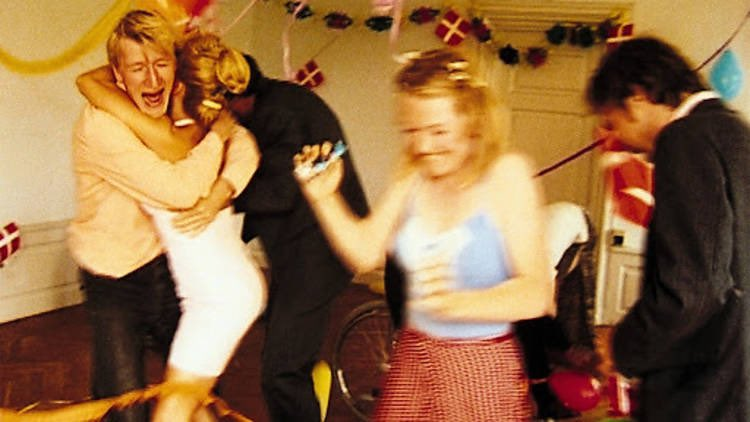
As divisive now as when it was released in 1998, The Idiots was nominated for a prestigious Palme d’Or at the Cannes Film Festival AND booed and criticised for its subject matter. In brief terms, the film is about a group of able-bodied people who, in seeking their ‘Inner Idiots,’ take on attributes of disabled people in public. 

Filmed in four days and with a largely non-narrative and improved script, the film begins with Karen (Bodil Jørgensen), a polite, shy, quiet, severely unhappy woman – with a delicacy not unlike Emily Watson as Bess in Breaking the Waves – who is eating lunch in a restaurant alongside a group of disabled adults. While the other diners look on, aghast at their behaviour, Karen’s kindness and curiosity lead one of the group, Stoffer (Jens Albinus), to take a shine to her. Karen, who, through her own desires and actions – they don’t force her – goes back to their residence, where she learns the truth: this is all an act, Stoffer is house-sitting for his rich Uncle while the house is on the market, and the group take turns to (disgracefully) act out various forms of disability in public to, as they claim, free themselves from the trappings of their day to day lives. 

Stoffer is cultish in his self-appointed leadership role, and while the others leave their inner Idiot at the commune’s door, Stoffer believes they should take it home to their families and let it into their personal lives. This is one example where the group is not as unified as first thought, and one of the ways they start to splinter as a unit. Another occurs when a commune member invites a group of individuals with Down’s syndrome to tea at the house. Stoffer storms off while the others display genuine tenderness, compassion, and kindness towards these strangers. At that moment, it appears Stoffer has become one of the very individuals in the restaurant he was attempting to rail against. 

The film does have one of two genuinely funny moments not hinged on their unacceptable behaviour. When the group visits a factory, and the foreman gets Stoffer to drive the van home, it’s funny because seeing someone drive a vehicle non-fatally into bushes is always funny. There are also jaw-dropping moments of graphic nudity and sex. But at the same time, putting these moments of hilarity into a film such as this implies von Trier is pointing to the audience by saying, “Yes, these people are deplorable, their actions are abhorrent, yet you are still finding moments of humour.” 

But underneath it all, there is a tragedy, as many of these people have been broken by various situations in their personal lives and found freedom and community in this group of people’s unacceptable actions. Karen’s is by far the most interesting story – a broken woman in a deep pit of grief who has found the family and affection she craves and a form of therapy through the group. This culminates in a powerful final scene after Karen returns to the home she originally fled, revealing both the grief that sent her running, and the healing she achieved in this community.

Film Intro: “Imitation of Life” (1959) [MAC Birmingham, 30/06/24]

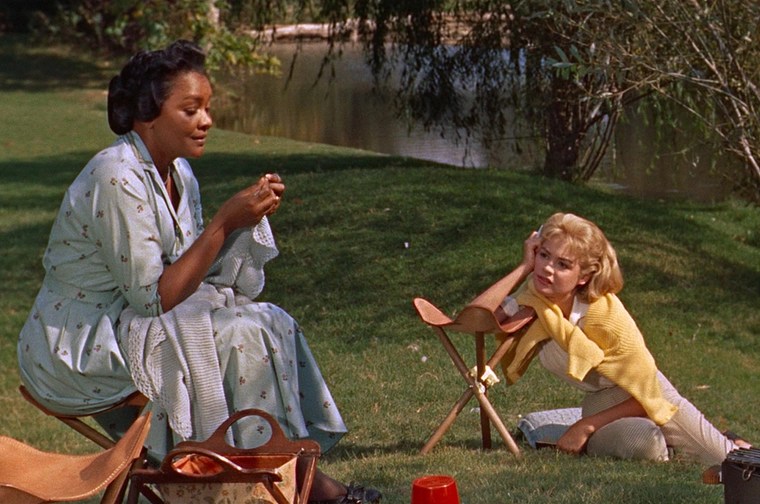
There is no melodrama like a Douglas Sirk melodrama, and Imitation of Life (1959) is no exception. It’s a powerful film, a key Sirk text, and a potent story about motherhood, race, class, and gender. To quote the BFI, “Douglas Sirk’s final Hollywood feature is a remake of John Stahl’s [1934] film of Fannie Hurst’s novel about two single mothers, one white, one black, striving together in a man’s world. It focuses, with typically sharp irony and intelligence, on issues of racial prejudice and inequality.”

Imitation of Life film centres on two sets of mothers and daughters, the Merediths (who are white) and the Johnsons (who are Black). In the opening scene, the young girls meet on the beach, and instantly become best friends. Susie has gone wandering from her mother to play with Sarah Jane, and this is where Lora (Lana Turner) finds her daughter, in Annie’s (Juanita Moore’s) care. Lora assumes Sarah Jane is white and Annie’s is her black babysitter, and is suprised to learn Sarah Jane is Annie’s fair-skinned multiracial daughter. On learning Annie and Sarah Jane have nowhere to stay, Lora invites them home for the night, but the close friendships between both sets of mothers and daughters build and bind, and we see this unit — this family —over the next eleven years as the girls mature.

In the other mother, both girls find something they desire, and what their own maternal figure lacks: Susie longs for her mother’s love rather than her actress mother’s glamour and fame, while Sarah Jane deliberately performs whiteness to achieve a higher quality of life – not out of distain for her mother, but survival as a part-black woman in a white man’s world. As Claire White wrote in her piece ‘The kids are not alright: Imitation of Life, “in many coming-of-age stories, white girls such as Susie are afforded the luxury to have relatively trivial concerns, whereas girls of colour such as Sarah Jane have bigger, societal issues to deal with.” As White continues, “while Sarah Jane (played as a teenager by Susan Kohner) tries to live a life of her own, far, far away from her darker-skinned mother who is always at home, Susie (Sandra Dee) just wants to talk about boys, kissing and algebra with her mother, who has become a successful Broadway actress and thus is never around.”

Over the course of the film, Sarah Jane perpetuates the fallacy that she is white and is constantly annoyed when Annie continues to kindly point people to the truth. When Sarah Jane’s race is discovered by a boy, with upsetting consequences, both mothers and daughters have a different perception of what this means and where the blame lies.

Sirk was keen to provide the Annie–Sarah Jane relationship in his version with more screen time and intensity than the characters were given in the 1930s versions of the story, and the critical consensus was that Juanita Moore and Susan Kohner (who was born to Roman Catholic mother of Irish and Mexican descent and a Czech Jewish father) stole the film from Lana Turner (which, as you will see, they did). The on-screen mother and daughter were individually nominated in the Best Supporting Actress category at both the Academy Awards and Golden Globes of 1959 with Kohner winning The Globe for her performance. Sirk said that he had deliberately and subversively undercut Turner to draw focus toward the issues of the two black characters, and his treatment of racial and class issues is admired for its perceptiveness of the times.

While their problems are very different, both sets of mothers and daughters have a degree of disconnect, and this is indicative of the time as the generational divide of 1950s America increased the sense of alienation between youth and adults. This has been echoed by the sociologist Kenneth Keniston, who in 1965 wrote that “the rapid advancement in technology meant that the future for the youth of that era was more unknowable and uncertain than for any generation before it.” And we see this divide between Lora and Annie, and Susie and Sarah Jane, who lacking the guidance they seek at home in the care of their mothers, find “it is only through distance from the home that they can forge their own path.” There is a moment when Annie apologises for loving her daughter “too much,” but still — as painful as it is — understands that she can only live her life and forge her independent identity if she sets her free. There is an unspoken bond between them, although Sarah Jane isn’t aware of its significance before it’s too late.

While Sirk’s version of Imitation of Life was not especially well-reviewed upon its original release —  it was compared to a soap opera and deemed inferior to its 1934 predecessor — it became the sixth highest-grossing film of 1959, making $6.4 million. It’s now far more famous than Stahl’s version and is considered a masterpiece of Sirk’s American career. The critic Emanuel Levy wrote that “one of the four masterpieces directed in the 1950s, the visually lush, meticulously designed and powerfully acted Imitation of Life was the jewel in Sirk’s crown, ending his Hollywood’s career before he returned to his native Germany.”

Imitation of Life is a film that endures, and continues to inspire various contemporary works of media. Todd Haynes’s 2002 film Far from Heaven is a homage to Sirk’s films, notably All That Heaven Allows (1955) and Imitation of Life, while R.E.M.’s 2001 song “Imitation of Life” took its title from the film (despite none of the band members having seen it). Additionally, the 1969 Diana Ross & the Supremes song “I’m Livin’ in Shame” is based on the film, and in 2015, BBC Online ranked the film as the 37th greatest American movie ever made, based on a survey of film critics.

Film Intro: Bette Gordon’s “Variety” (1983) [MAC Birmingham, 06/01/24]

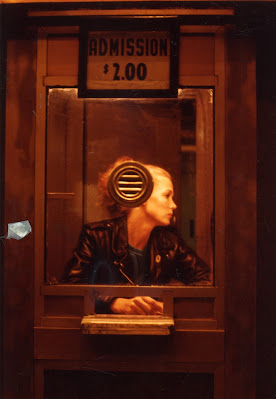
Nan Goldin, ‘Variety’ booth, NYC, 1983.

‘The intense desire – and the fulfilment of that desire – experienced through looking.’ – “Scopophilia,” as defined by the artist Nan Goldin.

In a July 2023 interview with the BFI’s Sight & Sound magazine — Entering the forbidden zone: Bette Gordon’s Variety at 40′ by Rachel Pronger — Variety’s director Bette Gordon said, “When you move to New York, one of the first things your family says is, ‘Don’t ever go out alone at night. But of course all I did was go out alone at night!” It was during this time, as a new resident of the city, that Gordon stumbled across the Variety, a dilapidated vaudeville theatre turned porn cinema. She was immediately transfixed, reminiscing: “Its neon marquee [was] right out of the past, right out of a movie. It looked delicious,” she said. “I couldn’t stop looking, the lights. It was like candy, it was just calling me.”

In her landmark text, ‘Visual Pleasure and Narrative Cinema,’ the film theorist Laura Mulvey wrote, ‘It’s the place of the look that defines cinema. The possibility of varying it, exposing it.” Mulvey’s explicitly feminist and groundbreaking thesis provoked enduring discussions about how women are presented and perceived – or looked at – in the arts. Using psychoanalysis and Freudian theory, Mulvey notes that the traditional on-screen gaze positions ‘woman as object, man as bearer of the look.’

As soon as she started making films, Gordon became obsessed with what she described as “the seduction of the image.” In her 2011 article for Artforum titled ‘Look Both Ways’: Amy Taubin on Bette Gordon, the critic and writer Taubin writes, ‘Bette Gordon’s films have always put women first. The sense of adventure in Gordon’s movies springs from her depiction of women’s psyches and bodies, desires and fears.’

Gordon began making short films in the mid-1970s in the Midwestern United States, all experimental works dealing with movement through place, sexuality, culture, and structure. Although her early work was more in line with structuralist filmmaking, she soon became involved with issues combining film and feminism, and rather than pander to the voyeurism of the male gaze, Gordon, as Taubin writes, ‘insisted on training her camera on women, often unclothed.’ She continues, ‘Gordon realised that the problem of the objectification of women in film has less to do with the display of the body than with who has control of the narrative—of the desire that motors it and of how that desire is resolved, or left as an opening into the unknown. She also understood, psychologically and pragmatically, that for a woman to become a filmmaker or to simply enjoy movies, she had to take pleasure in her own voyeurism.’

As Gordon told Sight & Sound. Variety is ‘a story about looking.’ The film centres on Christine, a young Midwestern woman (played by Sandy McLeod), who finds liberation working at a New York City pornographic theatre and becomes increasingly obsessed with a patron who is potentially involved with organised crime.

Based on a (loosely autobiographical) story by Gordon, Variety boasts a screenplay by Kathy Acker, a dynamic writer associated with and influenced by the New York Punk Scene of the late 1970s and early 1980s. Acker was at the forefront of postmodernism before postmodernism was popular and heavily influenced by experimental writers, including William S. Burroughs and Marguerite Duras, formulating a body of work combining cut-ups of passages and pastiche alongside biography, power, sex and violence.

Variety co-stars the photographer, activist, and the 2023 most influential art figure of the year recipient, Nan Goldin, as Christine’s friend Nan. The Tin Pan Alley bar where Nan works on screen was the Bowery bar where Goldin worked at the time, and which featured alongside the bar’s regulars – friends and sex workers – in her renowned photographic Slide Show The Ballad of Sexual Dependency. Goldin also documented the film via various gorgeous on-set images. 

Gordon has described Variety as a “part-document, part-narrative, part-desire-filled-landscape of New York at that moment in time”. A Hitchcock fan, Gordon presents Variety as an inverted noir, drawing inspiration from Vertigo (1958) and the idea of what would have transpired if Kim Novak had stalked James Stewart: woman as ‘Investigator’, man as ‘Enigma’. As Gordon reflects, ‘With Variety, I said, let me see if I can have the female as subject. [Christine] transgresses the limits of the situation. She’s the voyeur.’

Variety is a presentation of politics, cinephilia, art, and feminism. The film claims the gaze while disrupting the boundaries of male and female spaces. Early in the movie, while on break, Christine sneaks into the cinema at Variety, as equally fascinated by the men in the theatre as she is by the women – and images – on the cinema’s screen. As Christine’s obsession increases so does her confidence, and she starts boldly entering traditionally thought-of ‘male-dominated spaces’ or once ‘off-limits’ to women: a baseball game, a sex shop, a nocturnal market, all places where ‘man’s business’ is done. 

As an independent art film, and to contrast so much Hollywood mainstream fare or even the porn watched by Christine in the film, Gordon refuses to offer narrative catharsis and tie the ending in a neat bow. While contentious to some audience members who seek closure before the end credits roll, Gordon admits, ‘the ending didn’t offer what the audience wanted,’ and is keen to stress curiosity and the grey area — or “empty space” — of desire. Susanna Moore’s book In the Cut also does this very well. Moore’s 1995 book, adapted for the screen by Jane Campion in 2003 (Campion also directed the film), has a divisive ending that differed drastically from the book. Still, fundamentally, it is another crucial New York film about, among various things, women’s desire, sexual power, and risk.

Yet this “empty space,” this ambiguity, is part of Variety’s enduring appeal, prompting discussions, interpretations, and evolving opinions that only occur over time and with the audience’s shifting perceptions. Gordon told Sight & Sound that recent audiences, whether watching the film for the first time or due to their evolving politics over the years, appear increasingly receptive to the film’s provocations. As Gordon said, ‘For me, I want to enter the forbidden zone. Variety forces the spectator, the viewer, to recognise [their] own complicity, [their] own voyeurism… I don’t want to suppress the imagination. And maybe Variety is open to the imagination.’

*Film introduction for at Midlands Arts Centre, Birmingham, January 6 2024.

Film Season: Bad Mums

For those in Birmingham and the West Midlands – as well as those interested – the Midlands Arts Centre has programmed an incredible season of films titled ‘Bad Mums: Motherhood In Cinema.’ Kicking off in late June, I am fortunate to be presenting four of the ten films screening over the summer. Head over to the MAC’s Cinema page for more information—and I hope to see some of you there.