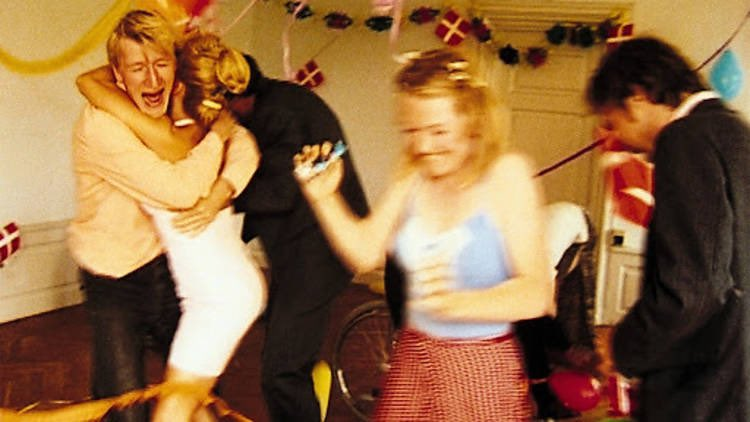
Film Intro: “The Idiots” [MAC Birmingham 10/09/23]

Lars von Trier’s 1998 pitch-black comedy-drama The Idiots, I won’t deny, is a tricky one to introduce and probably the most volatile of LvT’s films. It was the first to be made in total accordance with the Dogme 95 Manifesto (as established in previous weeks, Breaking the Waves was the first film he completed following the manifesto’s conception). The Idiots, often called Dogme # 2, is also the second in LvT’s Golden Heart Trilogy, succeeding Breaking the Waves and preceding Dancer in the Dark.

While Luis Buñuel’s 1972 Discreet Charm of the Bourgeois was about disrupting a well-to-do couple’s lavish dinner party in Surrealist style, it was funny rather than offensive. In Kristoffer Borgli’s 2022 film Sick of Myself,  a young woman called Signe (played brilliantly by Kristine Kujath Thorp) starts taking illegal drugs to make herself ill in a quest for celebrity. Sick of Myself was often rip-roaringly funny for showcasing the inherent narcissism prevalent in the social media age, and while it was called shallow in parts, human beings are frequently shallow people who thrive on attention, which made Signe’s narcissist devices to gain fame so funny. We could say that The Idiots paved the way for such a nihilistic satire, albeit in a very confrontational, controversial, and extreme way.

In every Lars von Trier film, he asks us to confront something deeply uncomfortable about the human condition: in Antichrist, it is grief and violence. In Breaking the Waves, the limits of faith and love. While it is impossible to shy away from The Idiots’ incredibly provocative and offensive subject matter and brazen bad taste, von Trier’s iconoclasm and taboo-shattering work still exposes sociological behaviour codes, ideas of normalcy, and conditioned emotional responses.

As divisive now as when it was released in 1998, The Idiots was nominated for a prestigious Palme d’Or at the Cannes Film Festival AND booed and criticised for its subject matter. In brief terms, the film is about a group of able-bodied people who, in seeking their ‘Inner Idiots,’ take on attributes of disabled people in public. 

Filmed in four days and with a largely non-narrative and improved script, the film begins with Karen (Bodil Jørgensen), a polite, shy, quiet, severely unhappy woman – with a delicacy not unlike Emily Watson as Bess in Breaking the Waves – who is eating lunch in a restaurant alongside a group of disabled adults. While the other diners look on, aghast at their behaviour, Karen’s kindness and curiosity lead one of the group, Stoffer (Jens Albinus), to take a shine to her. Karen, who, through her own desires and actions – they don’t force her – goes back to their residence, where she learns the truth: this is all an act, Stoffer is house-sitting for his rich Uncle while the house is on the market, and the group take turns to (disgracefully) act out various forms of disability in public to, as they claim, free themselves from the trappings of their day to day lives. 

Stoffer is cultish in his self-appointed leadership role, and while the others leave their inner Idiot at the commune’s door, Stoffer believes they should take it home to their families and let it into their personal lives. This is one example where the group is not as unified as first thought, and one of the ways they start to splinter as a unit. Another occurs when a commune member invites a group of individuals with Down’s syndrome to tea at the house. Stoffer storms off while the others display genuine tenderness, compassion, and kindness towards these strangers. At that moment, it appears Stoffer has become one of the very individuals in the restaurant he was attempting to rail against. 

The film does have one of two genuinely funny moments not hinged on their unacceptable behaviour. When the group visits a factory, and the foreman gets Stoffer to drive the van home, it’s funny because seeing someone drive a vehicle non-fatally into bushes is always funny. There are also jaw-dropping moments of graphic nudity and sex. But at the same time, putting these moments of hilarity into a film such as this implies von Trier is pointing to the audience by saying, “Yes, these people are deplorable, their actions are abhorrent, yet you are still finding moments of humour.” 

But underneath it all, there is a tragedy, as many of these people have been broken by various situations in their personal lives and found freedom and community in this group of people’s unacceptable actions. Karen’s is by far the most interesting story – a broken woman in a deep pit of grief who has found the family and affection she craves and a form of therapy through the group. This culminates in a powerful final scene after Karen returns to the home she originally fled, revealing both the grief that sent her running, and the healing she achieved in this community.

Film Intro: “Antichrist” [MAC Birmingham 09/09/23]

In 2006, Lars von Trier was hospitalised for depression and started writing Antichrist, the first film in what would become known as his “Depression Trilogy.” (Melancholia followed in 2011, and Nymphomaniac in 2013). 

Filmed in 40 days on a 4K digital camera, Antichrist was the first of LvT’s films to be shot entirely in Germany and was heavily influenced by horror – the director had watched the Japanese horror films Ring and Dark Water, although he is reluctant to describe Antichrist as a horror film (yet it is often labelled as art horror or psychological horror). At the same time, Von Trier had watched a documentary about European forests which detailed the violence of nature, and how these beautiful places are dark landscapes of pain. For LvT, nature “represents pure Hell,” yet people are still content to hang paintings of it in their homes. 

Antichrist is about a couple, Willem Dafoe and Charlotte Gainsbourg — credited as “He” and “She” — who retreat to the woods, or Eden, after the tragic accidental death of their infant son. The tragedy plays out in a breath-taking prologue, or opening sequence, as the couple are having sex in their home. The powerful black and white scene has no dialogue but is scored to Lascia Ch’io Pianga from Handel’s opera Rinaldo (the translation of Lascia Ch’io Pianga is “let me weep.”) Von Trier would use the aria again in Nymphomaniac (which starred Gainsbourg and featured Dafoe in Vol. 2). 

After “She” collapses at the funeral and spends a month in hospital under the diagnoses of atypical grief, “He” — a therapist with a distrust of psychoanalysis — has his wife discharged from hospital and takes it upon himself to counsel her himself (clearly a bad idea for a greiving father). His course of action is exposure therapy — making her confront her greatest fears to overcome her grief — and seeing as her second greatest fear is nature, they hike to the cabin in the woods where she had spent the previous summer with their son writing her since abandoned thesis. But through this journey of mourning, something wild and sinister is unleashed, and the film powerfully explores themes including sexual violence, sadomasochism, and the untamed wild power of nature.

There is also, obviously, a religious angle, “He” and “She” / Adam and Eve —but whatever your interpretation, it is a film rooted in mourning and despair.

Eva Green had been originally approached for the lead, and despite her determination to do the film, her agents would not permit it. In von Trier’s words, “Charlotte came in and said, ‘I’m dying to get the part no matter what.’ So I think it was a decision she made very early and she stuck to it. We had no problems whatsoever.” Gainsbourg has said she knew little of von Trier before their first meeting, although she knew his films and was highly anxious before they met in person. She was also concerned about the film’s more emotional sequences because LvT’s leads often go to very dark, frequently violent and/or intense places. She was also worried about depicting her character’s panic attacks and anxiety as she had experienced them herself.

Dafoe had previously worked with von Trier in 2005’s Manderlay, and had contacted the director to ask what he was working on around the time Antichrist was in its infancy. Of the role, Dafoe said, “I think the dark stuff, the unspoken stuff is more potent for an actor. It’s the stuff we don’t talk about, so if you have the opportunity to apply yourself to that stuff in a playful, creative way, yes, I’m attracted to it.” 

Antichrist, as is the pattern with LvT’s films, polarised its audience when it premiered at the 2009 Cannes Film Festival — there were walkouts and a handful of fainters. When questioned at the film’s press conference, von Trier commented that he had no need to justify the film because the audience were his guests and “not the other way around,” and claimed to be the best director in the world. The ecumenical jury at the Cannes festival gave the film a special “anti-award,” declaring Antichrist “the most misogynist movie from the self-proclaimed biggest director in the world,” yet Charlotte Gainsbourg still won the festival’s award for Best Actress.

In a tragic line from the film to Gainsbourg’s personal life, her sister, the British fashion photographer Jane Barry, whose work appeared in numerous commercial magazines and newspapers (including Vogue and The Sunday Times Magazine), as well as collaborations with their mother (the late Jane Birkin) and sisters, died as a result of a fall from her fourth-floor apartment in the 16th arrondissement of Paris on 11 December 2013. So here you have a very sad connection to the film. Some of the images and Barry’s death may also remind you of the murder of artist Ana Mendieta.

Antichrist is a viewing experiences that stays with you. Numerous friends and acquaintances say once watched, they don’t need to watch it again for maybe a decade — or ever again — much like Gaspar Noé’s 2002 Irrévervisble (which starred Vincent Cassel and Monica Bellucci). Incidentally, there is another link to Noé, and something we can connect to the witch-hunts mentioned in Antichrist. In 2019, Gainsbourg worked with Noé on his experimental short film Lux Æternal alongside Betty Blue star Béatrice Dalle, both playing fictional versions of themselves (Dalle is directing Gainsbourg in a film in this case). The film begins with a short montage of 1920s-style documentary footage of witch torture, and features Gainsbourg in a witch-burning scene. Lux Æternal concludes with a Luis Buñuel quote which I believe is relevant to Antichrist: “Thank God I’m an Atheist.”

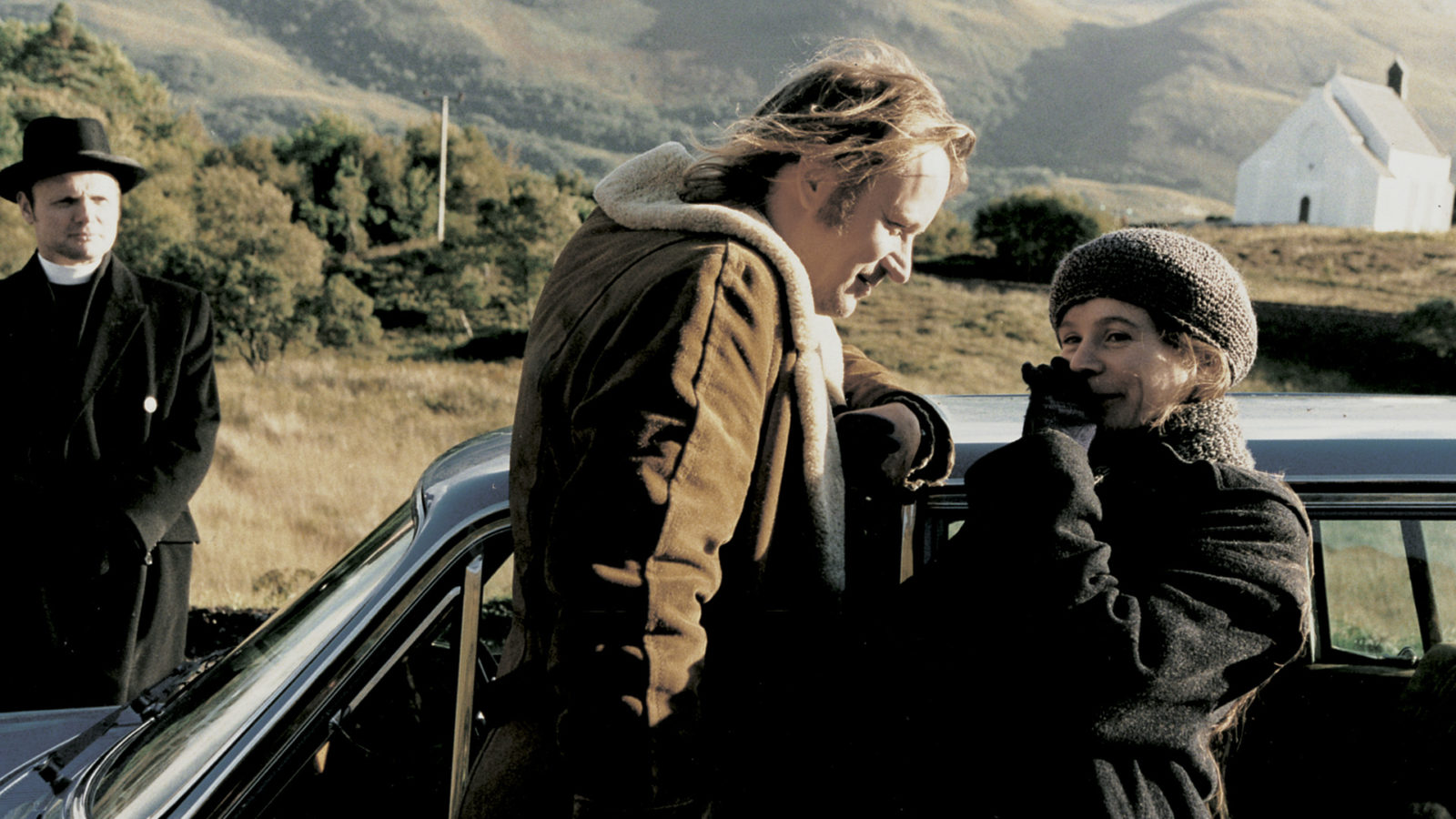
Film Intro: “Breaking the Waves” [MAC Birmingham 01/09/2023]

Breaking The Waves

In 1995, the controversial filmmaker Lars von Trier founded the Dogme 95 filmmaking movement with fellow Danish director Thomas Vinterberg. Dogme 95 was about creating films based on the traditional values of story, acting, and theme while excluding the use of elaborate special effects or technology – essentially a way for filmmakers to reclaim their power from the studios. While Breaking the Waves was the first film von Trier made after Dogme 95 and was inspired by its code, it wasn’t the first made in it’s vision (that title went to 1998’s The Idiots) because sets were built, music was added in post op, and computer graphics were used for the chapters title cards. However Breaking the Waves was shot entirely on Super35mm handheld camera which provides its naturalistic element, and is divided into chapters and an epilogue, with each chapter card filmed with a motionless camera but featuring movement in the panorama. In the original released theatrical cut, the epilogue featured David Bowie’s “Life on Mars,” later replaced by Elton John’s “Your Song” on early home video releases. The more recent Criterion edition restores the Bowie song.

Breaking the Waves was the first of von Trier’s films to feature a female protagonist (his earlier works have been said to “typically feature a disillusioned male idealist brought down by a deceitful woman”), and he would continue to write female leads in subsequent works. Yet von Trier’s female protagonists are often mired in controversy. Bess from Breaking the Waves is one such example.

Bess (played by the extraordinary Emily Watson) is a fragile young woman living in a religious and isolated Scottish town who has a history of mental health issues following her brother’s death. A woman of intense faith who converses with God, Bess is very pure, somewhat childlike, and fundamentally a good person – she is even described as being “good” in the film, and sometimes being too good a person has consequences. 

Bess’ image and fragility are why her marriage to Jan (Stellan Skarsgård), a trawler man working on a rig and not originally from the Island, is met with some disapproval from the local community. But Bess is besotted with Jan – he is her sexual awakening, she’s very clingy with him, and she finds it unbearable how his work takes him away from her for long periods of time. She says she “loves him too much.” 

Early in their marriage, and early in the film, Jan becomes paralysed following an accident at work. No longer able to physically satisfy his wife, Jan encourages Bess to sleep with other men and tell him about her adventures. When Bess relents to Jan’s voyeuristic desires, and Jan shows signs of improvement, she starts to believe her husband’s recovery is contingent on her actions. In convincing herself she has the power to heal, Bess essentially martyrs herself out of overwhelming love and devotion to her husband.

Some critics viewed Bess as a self-sacrificing submissive heroine and misogynist cliché, while von Trier’s themes of female sexual perversity, phallocentrism, and martyrdom – which would be continued in subsequent works – were also criticised. Yet what makes Breaking the Waves such an enthrallingly beautiful (and tough in parts, that’s undeniable) viewing experience is due to Watson, who is a force as Bess – an Academy Award nominated force – in what was, stunningly, her feature film debut. Watson is a beautifully physical actor (she does something similar in Anand Tucker’s Hilary and Jackie in her role of Jackie du Pré), and you see Bess’ physicality alter throughout the film depending on who she is with at any given time. Watson was actually expelled from the London College of Philosophy and Economic Science for taking on this role due to its graphic themes and nudity (the very reasons Helena Bonham Carter dropped out of the production), which is ironic given how Bess is ostracised by society in the film.

Huge praise must also be given to the late Katrin Cartlidge as Dorothy or the affectionately nicknamed “Dodo”, who plays Bess’ sister-in-law. A frequent collaborator of Mike Leigh who was due to play Patricia Clarkson’s roll in Dogville, the immensely talented Cartlidge tragically passed away in 2002 at the age of 41 due owing to complications from pneumonia and septicaemia (stemming from a pheochromocytoma). Dodo is Bess’ closest companion, a nurse in the hospital who is caring for Jan, and she is Bess’s pragmatic voice of reason.

Von Trier has often said he is an atheist, and wanted to make a naturalistic film that was also religious – Bess even compares herself to Mary Magdeleine at one point – but for it to be a film without any miracles. Breaking the Waves is often described as magical realism, and there is certainly a fantastical, almost spiritual, element, built-in. Undeniably, there are some gorgeous moments of metaphysical magic. 

Essentially, Breaking the Waves is a beautiful, shattering, film about love, devotion, the power and limits of faith, and the investment of belief to help the people you love.