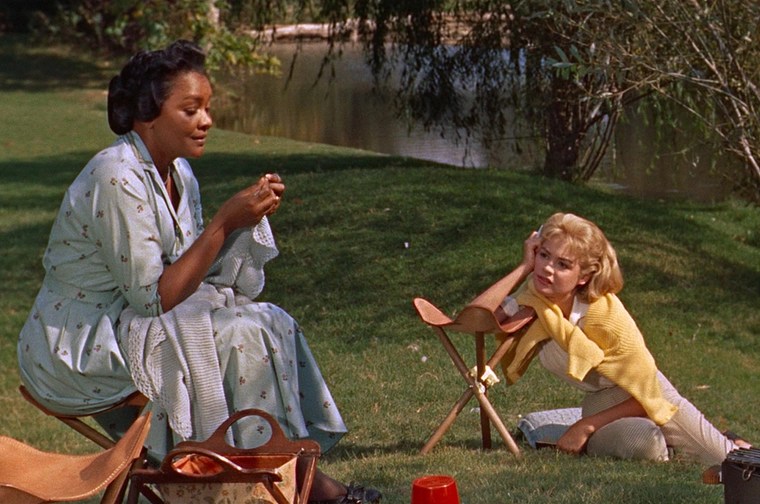
There is no melodrama like a Douglas Sirk melodrama, and Imitation of Life (1959) is no exception. It’s a powerful film, a key Sirk text, and a potent story about motherhood, race, class, and gender. To quote the BFI, “Douglas Sirk’s final Hollywood feature is a remake of John Stahl’s [1934] film of Fannie Hurst’s novel about two single mothers, one white, one black, striving together in a man’s world. It focuses, with typically sharp irony and intelligence, on issues of racial prejudice and inequality.”
Imitation of Life film centres on two sets of mothers and daughters, the Merediths (who are white) and the Johnsons (who are Black). In the opening scene, the young girls meet on the beach, and instantly become best friends. Susie has gone wandering from her mother to play with Sarah Jane, and this is where Lora (Lana Turner) finds her daughter, in Annie’s (Juanita Moore’s) care. Lora assumes Sarah Jane is white and Annie’s is her black babysitter, and is suprised to learn Sarah Jane is Annie’s fair-skinned multiracial daughter. On learning Annie and Sarah Jane have nowhere to stay, Lora invites them home for the night, but the close friendships between both sets of mothers and daughters build and bind, and we see this unit — this family —over the next eleven years as the girls mature.
In the other mother, both girls find something they desire, and what their own maternal figure lacks: Susie longs for her mother’s love rather than her actress mother’s glamour and fame, while Sarah Jane deliberately performs whiteness to achieve a higher quality of life – not out of distain for her mother, but survival as a part-black woman in a white man’s world. As Claire White wrote in her piece ‘The kids are not alright: Imitation of Life’, “in many coming-of-age stories, white girls such as Susie are afforded the luxury to have relatively trivial concerns, whereas girls of colour such as Sarah Jane have bigger, societal issues to deal with.” As White continues, “while Sarah Jane (played as a teenager by Susan Kohner) tries to live a life of her own, far, far away from her darker-skinned mother who is always at home, Susie (Sandra Dee) just wants to talk about boys, kissing and algebra with her mother, who has become a successful Broadway actress and thus is never around.”
Over the course of the film, Sarah Jane perpetuates the fallacy that she is white and is constantly annoyed when Annie continues to kindly point people to the truth. When Sarah Jane’s race is discovered by a boy, with upsetting consequences, both mothers and daughters have a different perception of what this means and where the blame lies.
Sirk was keen to provide the Annie–Sarah Jane relationship in his version with more screen time and intensity than the characters were given in the 1930s versions of the story, and the critical consensus was that Juanita Moore and Susan Kohner (who was born to Roman Catholic mother of Irish and Mexican descent and a Czech Jewish father) stole the film from Lana Turner (which, as you will see, they did). The on-screen mother and daughter were individually nominated in the Best Supporting Actress category at both the Academy Awards and Golden Globes of 1959 with Kohner winning The Globe for her performance. Sirk said that he had deliberately and subversively undercut Turner to draw focus toward the issues of the two black characters, and his treatment of racial and class issues is admired for its perceptiveness of the times.
While their problems are very different, both sets of mothers and daughters have a degree of disconnect, and this is indicative of the time as the generational divide of 1950s America increased the sense of alienation between youth and adults. This has been echoed by the sociologist Kenneth Keniston, who in 1965 wrote that “the rapid advancement in technology meant that the future for the youth of that era was more unknowable and uncertain than for any generation before it.” And we see this divide between Lora and Annie, and Susie and Sarah Jane, who lacking the guidance they seek at home in the care of their mothers, find “it is only through distance from the home that they can forge their own path.” There is a moment when Annie apologises for loving her daughter “too much,” but still — as painful as it is — understands that she can only live her life and forge her independent identity if she sets her free. There is an unspoken bond between them, although Sarah Jane isn’t aware of its significance before it’s too late.
While Sirk’s version of Imitation of Life was not especially well-reviewed upon its original release — it was compared to a soap opera and deemed inferior to its 1934 predecessor — it became the sixth highest-grossing film of 1959, making $6.4 million. It’s now far more famous than Stahl’s version and is considered a masterpiece of Sirk’s American career. The critic Emanuel Levy wrote that “one of the four masterpieces directed in the 1950s, the visually lush, meticulously designed and powerfully acted Imitation of Life was the jewel in Sirk’s crown, ending his Hollywood’s career before he returned to his native Germany.”
Imitation of Life is a film that endures, and continues to inspire various contemporary works of media. Todd Haynes’s 2002 film Far from Heaven is a homage to Sirk’s films, notably All That Heaven Allows (1955) and Imitation of Life, while R.E.M.’s 2001 song “Imitation of Life” took its title from the film (despite none of the band members having seen it). Additionally, the 1969 Diana Ross & the Supremes song “I’m Livin’ in Shame” is based on the film, and in 2015, BBC Online ranked the film as the 37th greatest American movie ever made, based on a survey of film critics.
 Sabina Stent