Film Intro: “Benny’s Video” [MAC Birmingham 30/08/2025]

Benny's Video (1992) | The Criterion Collection

In an interview for the Criterion Channel, Michael Haneke described what sparked the idea for Benny’s Video. His candid explanation was, “I wanted to know what it was like”.

“It’s a sentence I read once in a magazine,” he said, “that told the story of a crime committed by a boy  — it was a boy who killed another child or something like that. When the police interrogated him, that was his answer. And I was shocked by that.” Haneke spoke of collecting articles of this kind for the few years that followed, and the repetition of that sentence: I wanted to know what it was like.

“For me,” continued Haneke, “those are the words of a person out of touch with reality. When you learn life and reality only through the media, you have the sense that you’re missing something. If I see only a film, only images, even images of reality, a documentary, I’m always outside.” He wanted to be “inside”.

Riffing on the video game and handheld camera culture that came of age during the 1980s and continued into the 1990s, Benny’s Video (1992) – the second of Haneke’s first three feature films and the centre of his “Glaciation Trilogy” – succeeded The Seventh Continent (1989) and preceded 71 Fragments of a Chronology of Chance (1994). The trio of film were described by Criterion as “exploring the relationship among consumerism, violence, mass media, and contemporary alienation,” to “open up profound questions about the world in which we live while refusing the false comfort of easy answers.”

Benny’s Video stars Arno Frisch as Benny, a teenager with a predisposition towards violent images and obsessed with recording equipment, who documents practically everything via visual and audio means. Benny’s parents encourage their son’s “hobby” by way of affection, overcompensating for their lack of tenderness at home by buying all his equipment, oblivious to their son’s voyeuristic fascination with violence and how they are fuelling his habit. This fascination leads to a violent incident, with Benny intentionally recording the encounter – and its aftermath – the entire time.

In her book, Michael Haneke’s Cinema: The Ethic of the Image, film scholar Catherine Wheatley wrote that Benny’s Video prominently features “metatextual troubling of levels of reality” by incorporating Benny’s handheld camcorder footage, sound, and static cameras into the film, the result of which creates an “extremely distanced, ‘objective’ relationship to the narrative.”

As Haneke explained, “with an image, you cut the imagination short. With an image you see what you see, and it’s “reality.” With sound, just like with words, you incite the imagination, and that’s why, for me, it’s always more efficient”. “The image is the distancing and the sound is the manipulation,” he continues. “Using these two means, it gives an impression that’s complex enough to destabilise the viewer.”

Premiering at the 1992 Cannes Film Festival and opening the following Autumn at the 1993 New York Film Festival, Stephen Holden of The New York Times praised Frisch’s performance, writing, “what gives the film a chilly authenticity is the creepy performance of Arno Frisch in the title role. Cool and unsmiling, with a dark inscrutable gaze, his Benny is the apotheosis of what the author George W. S. Trow has called “the cold child,” or an unfeeling young person whose detachment and short attention span have been molded [sic] by television.” The controversial yet acclaimed film went on to win the International Federation of Film Critics (FIPRESCI) Award at the European Film Awards. 

Frisch continues this sadistic streak when he reteamed with Haneke for 1997’s Funny Games, which is interestingly the only one of Haneke’s films the director himself describes as lacking a semblance of guilt, something his other films all contain.  

Haneke always likes to leave open the answer to “why did someone do something?” as open as possible. “In this case,” he stresses, “the answer is only there to reassure and to calm the viewer,” because, he continues, “I think the reason for a crime or an accident is always much more complex than what you can describe and see on screen in 70 minutes.”

Benny’s Video remains unsettling, perhaps even more so in this age of mass surveillance, social media, the internet, and image manipulation. So many people live on their phones or through screens, and A.I. is making it more challenging to determine the authenticity of a still or moving image. We have a tendency to document everything we see rather than experiencing life in real time. Interestingly, Haneke never takes photographs or videos on his phone or otherwise when he’s on holiday. His reason? “I think it is completely perverse!”

Film Intro: “The Piano Teacher” [MAC Birmingham 20/07/2025]

Based on Elfriede Jelinek’s 1983 novel of the same name, Michael Haneke’s The Piano Teacher (2001) stars French force Isabelle Huppert as Erika Kohut. An unmarried thirty-something who teaches piano at the Vienna Music Conservatory, Erika lives with her domineering mother (Annie Girardot), with whom she shares a bed and a codependent relationship. 

Erika’s cool professional façade masks a woman besieged by loneliness and repressed sexual desire who satisfies her proclivities in private until she meets Walter (Benoît Magimel), a young engineer she reluctantly takes on as a student. Together, they embark on a relationship built on obsession and destructive infatuation, outlined by a set of rules imposed by Erika. The outcome is an affair that tows the line between freedom and control, desire and assault, power and submission. Hermione Hoby, in a 2010 article for The Observer, describes how this relationship “refracts and reiterates the parallels between the relationships of mother/daughter, teacher/pupil, captor/captive and abaser/abased.” 

The Piano Teacher, replete with its themes of masochism, rape, incest, sexual repression, and sexual violence, premiered at the 2001 Cannes Film Festival and immediately received rapturous acclaim, winning the festival’s Grand Prize as well as Best Actor for Benoît Magimel and Best Actress for Isabelle Huppert. 

The project arrived at the right time for Haneke, who had yet to receive a breakthrough after moving away from television, despite his Academy Award-nominated feature film debut, The Seventh Continent (1989). He followed this with other critically acclaimed films, including Benny’s Video (1992), Funny Games (1997), and Code Unknown (2000).

The Piano Teacher’s path was somewhat rocky; after numerous failed attempts, including Haneke’s involvement as a screenwriter but not as director, he was eventually asked to direct and agreed to do so on the condition that Huppert would star. Haneke had first wanted Huppert for Funny Games, and after informing her he would not direct The Piano Teacher without her, she read the screenplay and noted the film’s potential. Coincidentally, Huppert had studied piano as a child and quit at the age of fifteen, but resumed playing for the film. 

The beauty – if we can call it that – of The Piano Teacher is its stillness and unromanticism; its ability to unsettle and generate tension while showing so little. It’s a tantalising and thought-provoking film. As David Denby of The New Yorker wrote, “Haneke avoids the sensationalism of movie shockers, even high-class shockers like Hitchcock’s “Psycho” and Polanski’s “Repulsion”. There are no expressionist moments in The Piano Teacher—no scenes of longing, no soft-focus dreams or cinematic dreck”. 

Hoby, in her article, notes how book is even more unsettling, noting that “Erika and Walter’s relationship – and its catastrophic denouement – is even more powerful and disturbing than in Haneke’s telling.”

In his Criterion essay for the film titled “Breaking the Ice: The Beginning of Desire in The Piano Teacher”, Garth Greenwell writes that “Part of Haneke’s greatness lies in the way his static shots invite contemplation of compositions that have the density of great paintings. The more you look, the more you find to see. Here the composition is starkly geometrical, a lattice of vertical and horizontal lines. The image is inelegantly, even brutally cropped, the screen divided into four unequal vertical panels, two of them opaque: dull metal that occupies a quarter of the screen, more or less, and obscures our view of the scene beyond.”

Haneke is a master of off-screen tension (Caché, 2005, being another fine example), setting a scene coolly and letting us take our minds to those off-camera places, or the edge of the screen spaces. Even if we don’t want to go there, we find ourselves enraptured, unable to look away. One reason – the main reason – we cannot look away from The Piano Teacher is due to the extraordinary Huppert, who straddles the line between victim and perpetrator, portraying Erika as both repressed and seething, her ice queen exterior masking a torrent of stormy emotion, and described by Mick LaSalle of the San Francisco Chronicle as “a rich incarnation of a woman we might see on the street and never guess that she contains fires, earthquakes and infernos.” Both tightly wound and unleashed as Erika, if you’ve seen Huppert in Paul Verhoeven’s 2016 film Elle, you’ll see how this was very much a precursor to that performance and character. 

Peter Bradshaw of The Guardian writes that “this [The Piano Teacher] is the performance that Huppert hints at in the Chabrol movie Merci Pour le Chocolat: cold, malign and profoundly disturbed. Her face, innocent of make-up and adorned only by freckles, often looks like that of a strange 12-year-old living in her own private world. Close-ups look like the very last frame in Polanski’s Repulsion: a freaky vision of a mad, murderous little girl. Huppert rarely allows expression other than, say, a wince of fastidious disgust at some error of musical interpretation or keyboard address. In fact the only real expression comes at the very end: an extraordinary grimace of wrenching pain and self-loathing.”

Denby concludes that The Piano Teacher “is a seriously scandalous work, beautifully made, and it deserves a sizable audience that might argue over it, appreciate it—even hate it.”

Whether you love it or hate it, you certainly won’t forget it.

Film Intro: “Mulholland Drive” [MAC Birmingham, 19/04/25]

David Lynch once described living near Mulholland Drive: “At night, you ride on the top of the world,” he said. “In the daytime you ride on top of the world, too, but it’s mysterious, and there’s a hair of fear because it goes into remote areas. You feel the history of Hollywood in that road.”

Mulholland Drive is Lynch’s gorgeous Surrealist neo-noir, a mysterious fable about women, memory, identity, and Hollywood; a town built for movies and stardom but where illusions are shattered. The film works well as a double-bill with Billy Wilder’s Sunset Boulevard (1950), a road we see at the beginning of the film. At the 2001 press conference for Mulholland Drive, Lynch described the “human putrefaction” – the decay and corruption of humanity, especially in the Los Angeles film industry – within a city of “lethal illusions.” He believed that Wilder saw this condition and was equally fascinated by it, too. 

In Mulholland Drive, the lives of Betty (Naomi Watts) – “I came to L.A. to be a movie star” – and amnesiac Rita (Laura Harring), who has escaped a fatal car crash on the winding hills of Mulholland Drive, merge and collide. Both actors were cast purely by their photographs, and Lynch had not seen any of their previous work. Harring was involved in a minor car accident on the way to the first interview, something she considered an act of fate after learning her character would also be involved in an automobile collision. Watts based her portrayal of the wholesome Betty on various Hollywood blondes, including Doris Day, Tippi Hedren and Kim Novak. She described Betty as a thrill-seeker, someone “who finds herself in a world she doesn’t belong in and is ready to take on a new identity, even if it’s somebody else’s.”

Michael Wilmington of the Chicago Tribune said, “everything in Mulholland Drive is a nightmare. It’s a portrayal of the Hollywood golden dream turning rancid, curdling into a poisonous stew of hatred, envy, sleazy compromise and soul-killing failure.” Watts said her early experiences in Hollywood paralleled those of Diane’s (again, Watts in a dual role). Plus, she had her own history with the stretch: “I remember driving along the street many times sobbing my heart out in my car, going, ‘What am I doing here?’” she once said.

Mulholland Drive originated as a television pilot, and Lynch filmed the open-ended scenes in 1999. However, after television studios rejected the show, Lynch conceived an ending. Some audiences felt the effect, a part-show, part-film hybrid, lacked the cohesion of Twin Peaks (clearly a T.V. series; The Return, ironically, is considered a film) or Blue Velvet (a movie). 

As the Guardian’s film editor Michael Pulver wrote in his recent David Lynch tribute: 

“Initially it [Mulholland Drive] appeared to go disastrously wrong, as Lynch had pitched it as a Twin Peaks-style TV series. A pilot was shot and then cancelled by TV network ABC. But the material was picked up by French company StudioCanal, who gave him the money to refashion it as a feature film. A noir-style mystery drama, it was another big critical success, secured Lynch a third best director Oscar nomination and in 2016 was voted the best film of the 21st century.” 

Like most – if not all – of Lynch’s work, Mulholland Drive is open to dream analysis, especially given the film’s tagline of “love story in the city of dreams.” But it is also one of Lynch’s most linear films. One interpretation is that the real Diane Selwyn has cast her dream self as the sweet and optimistic Betty Elms, rewriting her past and self into her version of an old Hollywood film. This would fit in with some additional elements, including the casting of Ann Miller as Coco (an Old Hollywood star in her final film role), who represents the golden age of movies.

But in the film’s second half, the dreamer is woken up, and the illusion is shattered as the characters wake up to find themselves in Los Angeles purgatory. Watts had her own explanation of the film, which was closer to what many viewers believe to be true. As she said, “I thought Diane was the real character and that Betty was the person she wanted to be and had dreamed up. Rita is the damsel in distress and she’s in absolute need of Betty, and Betty controls her as if she were a doll. Rita is Betty’s fantasy of who she wants Camilla [Harring in a dual role] to be.” 

Harring, meanwhile, said, “When I saw it [Mulholland Drive] the first time, I thought it was the story of Hollywood dreams, illusion, and obsession. It touches on the idea that nothing is quite as it seems, especially the idea of being a Hollywood movie star. The second and third times I saw it, I thought it dealt with identity. Do we know who we are? And then I kept seeing different things in it…”

Mulholland Drive is a film where your opinion may change with every viewing, which is what makes every watch of the film so richly rewarding. What is real, what is the dream, and what’s the nightmare? I will leave you with a quote from The Cowboy, who I believe has one of the film’s most appropriate lines: “Hey, pretty girl. Time to wake up.”

Film Intro: “Lost Highway” [MAC Birmingham, 12/04/25]

In her August 1997 BFI piece “Voodoo Road,” the historian Marina Warner wrote, “the plot of Lost Highway binds time’s arrow into time’s loop, forcing Euclidian [sic] space into Einsteinian curves where events lapse and pulse at different rates and everything might return eternally.” She continues, “But this linearity is all illusion, almost buoyantly ironic, for you can enter the story at any point and the straight road you’re travelling down will unaccountably turn back on itself and bring you back to where you started.”

Lost Highway, David Lynch’s seventh feature film and his first after Twin Peaks: Fire Walk with Me, has all the markings of a quintessential LA film noir, but with a Lynchian nightmare spin. It’s a Moebius strip of a movie: multiple plots loop around and on themselves, and storylines run along parallel lines but never fully link together for total resolution. The film takes its title from a phrase in the book “Night People” by Barry Gifford, who also wrote the literary version of “Wild at Heart.” However, rather than adapting the source material, Lynch and Gifford decided to base the film on videotapes and a couple in crisis. 

As Lynch detailed in his autobiography “Room to Dream”:

“Another beginning idea was based on something that happened to me. The doorbell at my house was hooked to the phone, and one day it rang and somebody said, “Dick Laurent is dead.” I went running to the window to see who it was, but there was nobody there. I think whoever it was just went to the wrong house, but I never asked my neighbors if they knew a Dick Lau-rent, because I guess I didn’t really want to know.”

The result is a two-tale story: in the first, Jazz saxophonist Fred Madison (Bill Pullman) is fixated that his wife Renee (Patricia Arquette) is having an affair, and suddenly finds himself in prison, accused of her murder. In the second, you have the young mechanic Peter Dayton (Balthazar Getty) and the blonde temptress/ adulterous gangster’s moll, Alice. The only constant is Arquette in her dual roles, and, as Warner says at this middle point, “the film changes from an ominous Hitchcockian psycho-thriller to a semi-parodic gruesome gangster pic.” Arquette’s dual femme fatale roles also heighten the noir element, she is Uma Thurman-esque with her blunt brunette fringe, then Marilyn Monroe-like with her soft blonde waves. We also have the brunette/blonde dual role – or self – in Mulholland Drive.

The film’s casting is inspired. Robert Blake – who did not understand the script at all – is incredibly creepy as the sinister mystery man, his portentous appearance taking on a new significance since the Millennium. Best known as the 1970s television detective “Baretta,” in 2005 Blake was acquitted of murdering his then-wife Bonny Lee Bakley (following her murder in 2001). Richard Pryor appears in what was to be his final film role, and Robert Loggia. Loggia, previously annoyed about missing out on the role of Blue Velvet’s Frank Booth to Dennis Hopper, has an on-screen rant in Lost Highway that was unscripted and genuine. 

Another LA-appropriate influence was O.J. Simpson, particularly his ability to return to regular life despite an infamous high-profile court case. 

In her essay, “Funny How Secrets Travel: David Lynch’s Lost Highway,” the academic Alanna Thain writes, “David Lynch’s 1997 film Lost Highway is haunted by the specter of Alfred Hitchcock’s Vertigo (1958), itself a ghost story on many levels.” Vertigo is a film about male obsession, aggression, and visual control, described as a deconstruction of the male construction of femininity and of masculinity itself. The critic James F. Maxfield suggested that Vertigo is an interpreted and variation on Ambrose Bierce’s 1890 short story “An Occurrence at Owl Creek Bridge”, in which Scottie imagines the main narrative of the film as he dangles from a building at the end of the opening rooftop chase.

Thain continues, “Inspired by the spiral form that dominates Hitchcock’s masterpiece, Lost Highway explores the effects of living in a world characterized by paramnesia. A form of déjà vu, paramnesia is a disjunction of sensation and perception, in which one has the inescapable sense of having already lived a moment in time, of being a witness to one’s life.” In Lost Highway, did Fred murder his wife and then construct the rest of the outcome in a dream? And did that dream turn inwards into a nightmare? 

These themes have appeared in Lynch’s other works, most recently Twin Peaks: The Return – Agent Cooper/Dougie, and that ending – in which characters are caught in a never-ending cycle of purgatory, dreams, nightmares, doppelgängers, and déjà vu. As the Mystery Man says, “We’ve met before, haven’t we?”

Lost Highway is an uneasy film and one of the most unsettling in terms of how deep it goes in terms of Lynch’s dream/nightmare logic. In “Room to Dream” Lynch wrote, “it’s not a funny film because it’s not a good highway these people are going down. I don’t believe all highways are lost, but there are plenty of places to get lost, and there’s some kind of pleasure in getting lost. Like Chet Baker said, let’s get lost.” 

On that note, it’s time to get lost in Lost Highway.

Film Screenings: David Lynch at MAC Birmingham

I will be introducing two David Lynch gems – Lost Highway (Saturday 12 April) and Mulholland Drive (Saturday 19 April) at the Midlands Arts Centre. If you’re local, please do come along. Tickets are available on the MAC’s website or via the links above.

Film Intro: “Shock Treatment” [02/11/2024, MAC Birmingham]

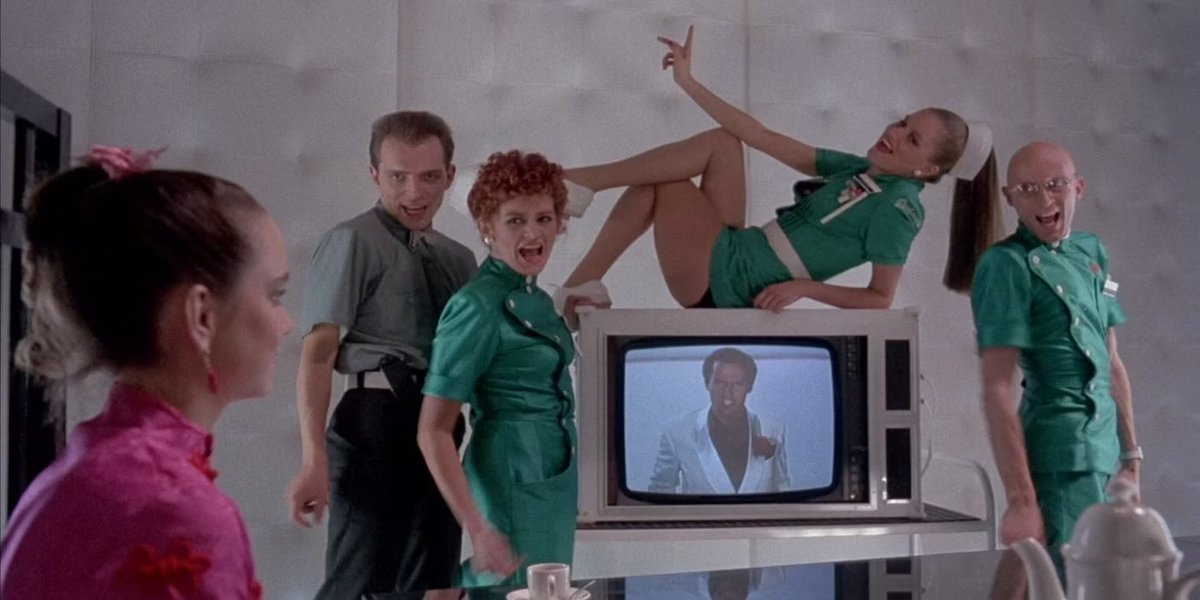
Directed by Jim Sharman, and with a script and lyrics by Richard O’Brien, Shock Treatment is 1981’s non-canon parallel film to the events of 1975’s immensely popular The Rocky Horror Picture Show born of two scrapped productions: Rocky Horror Shows His Heels and The Brad and Janet Show.

Following the unexpected and overwhelming success of Rocky Horror, especially on the midnight film circuit, Richard O’Brien approached producer Michael White with the idea of filming a sequel. In 1978, O’Brien started working on a script. Titled Rocky Horror Shows His Heels, it featured a resurrected Frank and Rocky, Brad and Dr. Scott now lovers, and Janet pregnant with Frank’s baby. However, Sharman was reluctant to revisit the material, and Tim Curry had no desire to reprise his scene-stealing turn of Dr Frank ‘N Furter. Yet because O’Brien had put considerable time and work into the songs, he retained the musical content and reworked the film’s premise.

The second script was titled The Brad and Janet Show—which was closer to what became Shock Treatment—but was plagued by problems during preproduction. Dr. Scott was included in this script version, but once again, reconvening the original cast proved problematic, with Jonathan Adams refusing to reprise his role as the Narrator. Then, in 1980, a problem arose that we have been familiar with in recent years: filmmakers intended to shoot on location in Denton, Texas, but the Screen Actors Guild went on strike, so all production ground to a halt.

However, the strikes revealed a silver lining: with cast and crew availability reduced, the filmmakers had to get creative with their resources. Television already featured heavily in the script, so production designer Brian Thomson had the idea to rework the story and set it in a giant TV studio. Utilising a film studio in the UK cut $1 million from the budget and gave the filmmakers a smaller, more controlled environment. In the final version of the script, all locations were changed to television shows, and the role of Dr. Scott evolved into game show host Bert Schnick. As O’Brien said of the changes, “I was frightened the strike was going to finish too soon and we’d have to go back to our original conception.”

In Shock Treatment, Brad and Janet Majors (Cliff De Young and Jessica Harper, the former who was ironically Sharman’s original choice for Rocky Horror but scheduling saw the role go to Barry Bostwick, and the latter succeeding a now unaffordable Susan Sarandon) are now married and living in Denton, USA. However, the town is controlled by a television network whose citizens are all part of the shows on the DTV network. It’s the original The Truman Show, because the audience members—as well as Brad and Janet—are all part of a television show. At first, they go on the game show Marriage Maze, hosted by the eccentric Bert Schnick (the fantastic Barry Humphries), who determines Brad is both an emotional cripple and mentally ill, and institutionalised in Dentonvale hospital as a “prize”. The treatment is administered by quasi-incestuous sibling doctors Cosmo and Nation McKinley (Richard O’Brien and Patricia Quinn), who are not real doctors at all but hosts of Dentonvale, the reality show.

Janet, meanwhile, has caught the eye of Farley Flavors (DeYoung in a dual role), the new owner/sponsor of DTV and the new show Faith Factory, who encourages her to pursue superstardom with the added caveat that her newfound celebrity will “cure” Brad. As a fun bit of trivia, DeYoung modeled his performance of Brad after David Eisenhower and based Farley on Jack Nicholson.

Shock Treatment never received a full general theatrical release, and due to both this and its inflated budget, the film was an even bigger financial flop than Rocky Horror’s original general release in 1975. The critic Roger Ebert felt Rocky Horror fans would reject a movie targeted specifically for them. As Ebert remarked, “cult film audiences want to feel that they have seen the genius of something that everybody else hates. They discovered this film, they know it’s good, everyone else thinks it’s garbage.”

This turned out to have a kernel of truth: Rocky Horror fans quickly labeled Shock Treatment as garbage, primarily due to Tim Curry’s absence and O’Brien infamously stating,” It’s not a sequel… it’s not a prequel… it’s an equal.” O’Brien later retracted his remarks but frequently criticized his own project. Gradually, however, Shock Treatment has built up a steady cult following all its own, away from Rocky Horror for what it is, something Ebert echoed: a film ahead of its time and a prescient satire of reality television.

And even Shock Treatment knows this is so. In one exchange of dialogue between Nation (Nic Lamont) and Cosmo (Adam Rhys-Davies), Nation says, “This could be worse than the old series.” “In the old series,” Cosmo replies, “we never had a convertible.”

Film Intro: “Serial Mom” [MAC Birmingham, 31/08/24)

In her July 2024 essay for CrimeReads, Julia Sirmons notes that “Serial Mom opens with title cards that mimic the typical true crime disclaimers: the film was based on interviews and witness testimony. And then,” she says, “there’s the kicker: “Some of the innocent characters’ names have been changed in the interest of a larger truth.’” As Sirmons notes, the quotation marks work in two ways: to protect crime fiction from liability, and to make a case for its own cultural legitimacy. “Waters,” she continues, “mimicking this, makes his satire reveal larger truths about American values and obsessions.”

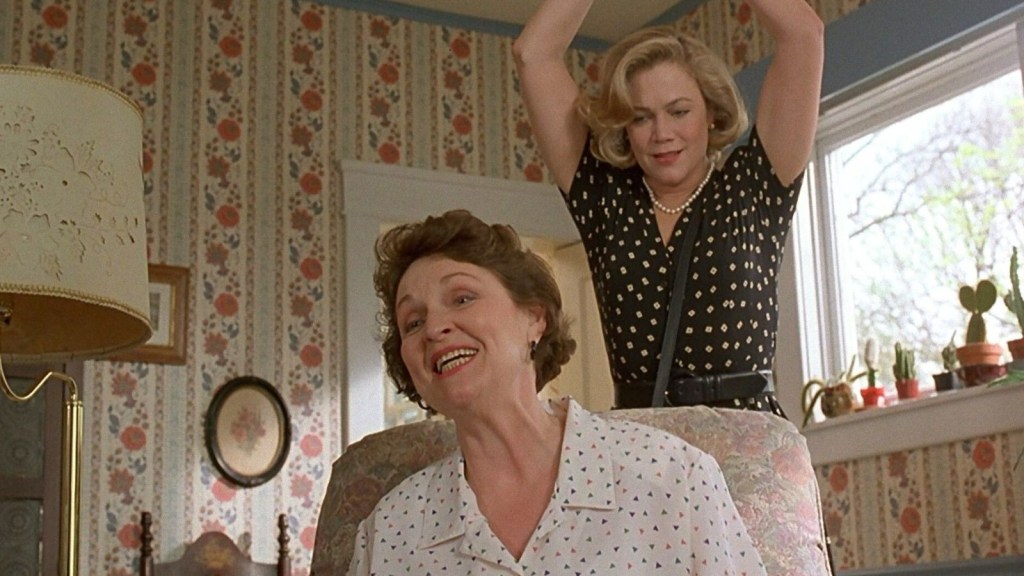
To say a filmmaker like John Waters relishes skewering various facets of human nature and family values—including obsessions with true crime and celebrity culture—would be an understatement, and we, his rapt audience, take perverse pleasure in his pride. This is perhaps why 1994’s Serial Mom, Waters’ satirical black comedy about a seemingly mild-mannered housewife with a murderous disposition, was the perfect vehicle for the provocateur affectionately dubbed the “Pope of Trash”, an auteur who takes every opportunity to expose the seedier and more perverted side of suburbia. Serial Mom is one of Waters’ best, yet it is seldom screened or broadcast; reviews were mixed at the time of release, and the film tanked at the box office (it grossed nearly $8 million). Yet Waters’ scathing comedic satire has since become a much-loved cult classic and favourite.

Serial Mom stars Kathleen Turner as Beverly Sutphin, alongside a supporting cast of Sam Waterston, Ricki Lake, and a pre-Scream Matthew Lillard as her on-screen family. The many cameos include heiress/fugitive Patty Hearst, the late actress and author Suzanne Somers—who appears as a fan hoping to portray her “feminist heroine” in a made-for-TV movie about Beverly’s life—alongside comedian/legend Joan Rivers, former porn star and actress Traci Lords, and Warhol Factory member Brigid Berlin. Both Lake and Lords are Waters darlings, having appeared in Cry Baby four years earlier.

On the surface Beverly is a polite and unassuming upper-middle-class housewife to her dentist husband and a doting mother to their teenage children, living in Towson, Maryland. (Waters likes to keep things loyal to his native Baltimore). However, as we know—whether via David Lynch’s Blue Velvet or the television series Desperate Housewives—never to be fooled by the niceties of suburbia and a white picket fence. Behind the perky demeanour, pie baking, and pinafores, Beverly is a phone-pranking, gore-loving, cold-blooded serial killer with a simple code: if you annoy her, she will murder you—and she will murder in broad daylight, on the high school grounds, or in the men’s bathroom of the local mall— for “perceived crimes against polite society,” whether that is wearing white after Labor Day or failing to rewind a rented VHS tape. Yet Beverly has no qualms in dirtying things closer to home, whether that be a neighbour who stole her parking space, a teacher criticising her son’s interest in horror films, or a love rat standing her daughter up for a date. Some might say she is a protective mother with her family’s interests at heart and no time for criticism of her children, qualities of a good and nurturing matriarch but executed (quite literally) in a manner that says otherwise. However, unlike most of the mothers in the MAC’s series of Motherhood on Screen, Beverly is the only one with serial killer paraphernalia under her mattress.

It is curious to think that Meryl Streep, Kathy Bates, Glenn Close, and even international treasure Julie Andrews had been considered for the role, but Turner is fantastic as Beverly, putting everything and then some into her portrayal. For the film’s inspiration, Waters’ drew on work by Doris Wishman, Otto Preminger, William Castle, and Herschell Gordon Lewis, and rather than conceal these influences, we see examples of their films playing on television sets at various points during Serial Mom. However, the audio we hear of Ted Bundy’s voice is not that of the jailed convicted murderer but the voice of Waters himself.

Having made his name in the early 1970s with transgressive cult films that riff on comedy and surrealism Waters has given us Multiple Maniacs (1970), Pink Flamingos (1972), Female Trouble (1974), Hairspray (1988) (which was later adapted into a hit Broadway musical and a 2007 musical film), as well as Polyester (1981), Cry-Baby (1990), Serial Mom (1994), Pecker (1998), and Cecil B. Demented (2000). Not one for subtlety, Waters never does things by half. Yet his work has such style and humour, and Serial Mom remains as riotous, fresh, and funny as it was thirty years ago. It’s impossible not to titter when Turner is pranking Waters’ long-time collaborator, Mink Stole, with the most over-the-top, preposterous insults, yielding—much like the rest of Serial Mom—some laugh out loud hilarious moments.

In her article, Sirmon noted the comparisons between the fictional Beverly and the factual Betty Broderick, a wealthy suburban mother who killed her ex-husband and his new wife after an acrimonious divorce in a murder case that gripped America’s fascination. “If Broderick,” Sirmon writes, “a picture-perfect Super Mom, could suddenly “snap” and become a killer, what were other seemingly-contended housewives capable of?”