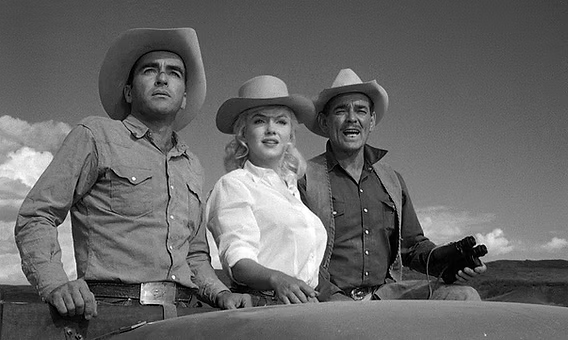
A love letter to his wife Marilyn Monroe. That was Arthur Miller’s intention behind The Misfits: a role to finally distance Monroe from her bombshell image and establish her as a serious actor. Instead the John Huston directed picture, based in the Nevada desert, is as much about death as it is about freedom. Clark Gable, cast as aged cowboy Gay, died shortly after the film was completed. We have Monroe playing nervous young divorcee Roslyn, shaking uncontrollably – more so than was required of her character – the black and white production could not conceal her poor skin, mental decline and physical health. She would be dead a few months later. For Montgomery Clift, as rodeo rider Perce, the role came five years after the horrendous car crash that scarred his once perfect features. It would be one of his final roles and Clift would be dead five years later, never having fully mentally recovered from the accident and the emotional turmoil caused by this disfigurement. The scars of his past haunt his character through the line of dialogue: “my face is fine. It’s all healed up. It’s just as good as new”. In him Monroe found a kindred spirit, admitting in a 1961 interview that he was “the only person I know who is in even worse shape than I am.” Heartbreaking.
When recently divorced Roslyn and her older friend (peerless Thelma Ritter) catch the eyes of ageing cowboy Gay and his friend Guido (Eli Wallach) in a bar they sidle over to their table. Soon they are inviting the women to Guido’s abandoned home, unfinished since his wife’s death, in the Nevada desert. The young woman and the older cowboy immediately become a couple – setting up home, fixing the ramshackle house and planting lettuce in the garden. Roslyn’s intense affection for all creatures – Gay’s dog, the rabbit Gay threatens to kill for eating their crops – is constantly on display, yet this part of her is shot-down for being soft and silly. They set off Mustanging – rounding up wild horses – and pick up Perce from the rodeo on their the way. In the Nevada desert we have an expanse of land that is as dry and cracked as a failed marriage, echoing with the emotional and physical scars of childless couples, deceased partners and love affairs been and gone. The expanse is as much about Miller and Monroe’s dry relationship as it is about the industry. When Perce tells Roslyn, “I don’t like to see the way they grind up women out here,” he could have been referring to Hollywood’s ability to spit out once lauded stars.
The whole mythology of The Misfits is grounded in its stars and a deep yearning for both happiness and freedom. All of the characters talk of liberation but they are the ones snatching it away from one another, and rounding up these free animals when they desire it from them the most. It is a phenomenal film with an explicable link to the industry, Hollywood history and forever entwined in the mythology of its stars. They are those Misfit horses who have been captured and lassoed, but in their legacies, in memory, they run eternally wild and free.
* This post originally appeared on my now defunct old blog, 10 June 2015.

 Sabina Stent