From the Archives: “The Misfits”

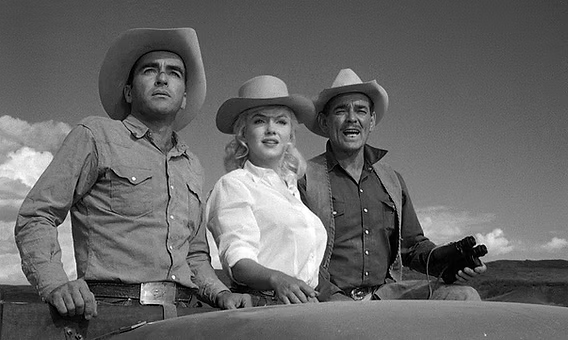
A love letter to his wife Marilyn Monroe. That was Arthur Miller’s intention behind The Misfits: a role to finally distance Monroe from her bombshell image and establish her as a serious actor. Instead the John Huston directed picture, based in the Nevada desert, is as much about death as it is about freedom. Clark Gable, cast as aged cowboy Gay, died shortly after the film was completed. We have Monroe playing nervous young divorcee Roslyn, shaking uncontrollably – more so than was required of her character – the black and white production could not conceal her poor skin, mental decline and physical health. She would be dead a few months later. For Montgomery Clift, as rodeo rider Perce, the role came five years after the horrendous car crash that scarred his once perfect features. It would be one of his final roles and Clift would be dead five years later, never having fully mentally recovered from the accident and the emotional turmoil caused by this disfigurement. The scars of his past haunt his character through the line of dialogue: “my face is fine. It’s all healed up. It’s just as good as new”. In him Monroe found a kindred spirit, admitting in a 1961 interview that he was “the only person I know who is in even worse shape than I am.” Heartbreaking.

When recently divorced Roslyn and her older friend (peerless Thelma Ritter) catch the eyes of ageing cowboy Gay and his friend Guido (Eli Wallach) in a bar they sidle over to their table. Soon they are inviting the women to Guido’s abandoned home, unfinished since his wife’s death, in the Nevada desert. The young woman and the older cowboy immediately become a couple – setting up home, fixing the ramshackle house and planting lettuce in the garden. Roslyn’s intense affection for all creatures – Gay’s dog, the rabbit Gay threatens to kill for eating their crops – is constantly on display, yet this part of her is shot-down for being soft and silly. They set off Mustanging – rounding up wild horses – and pick up Perce from the rodeo on their the way. In the Nevada desert we have an expanse of land that is as dry and cracked as a failed marriage, echoing with the emotional and physical scars of childless couples, deceased partners and love affairs been and gone. The expanse is as much about Miller and Monroe’s dry relationship as it is about the industry. When Perce tells Roslyn, “I don’t like to see the way they grind up women out here,” he could have been referring to Hollywood’s ability to spit out once lauded stars.

The whole mythology of The Misfits is grounded in its stars and a deep yearning for both happiness and freedom. All of the characters talk of liberation but they are the ones snatching it away from one another, and rounding up these free animals when they desire it from them the most. It is a phenomenal film with an explicable link to the industry, Hollywood history and forever entwined in the mythology of its stars. They are those Misfit horses who have been captured and lassoed, but in their legacies, in memory, they run eternally wild and free.

* This post originally appeared on my now defunct old blog, 10 June 2015.

Favourite First Time Watches – January 2025

Four films per month, from any year. If I can be logged on Letterboxd, it is eligible for inclusion.

Peeping Tom (Michael Powell, 1960)

“You won’t see that in Sight and Sound!”


Being John Smith (John Smith, 2024)

I could have watched another hour of this.

Part of “Being John Smith”.
CONDO hosting Tanya Leighton, Berlin & Los Angeles. On at Kate MacGarry until 15 Feb.


Babygirl (Halina Reijn, 2024)

Sweeter and warmer and funnier than I expected! I’m relieved to see it is indeed part of the “Eyes Wide Shut” universe, and I very much enjoyed Nicole’s loose-fit baby blue cashmere jumper.


A Quiet Place: Day One (Michael Sarnoski, 2024)

Apocalypse priorities: your cat and getting a pizza. I found this surprisingly emotional and profoundly moving – anyone who saw Quinn in “Dickensian” all those years ago knows the power of his tear-filled eyes. And Lupita – dragging her exhausted body from safe place to safe place over the course of the film – is, of course, extraordinary.

You can follow me on Letterboxd here: https://boxd.it/6CT7

My Top Twenty Films of 2024

Once again, you didn’t ask, and once again, I deliver: my Top 20 Films of 2024 – loosely ranked! – of titles to appear on the UK’s official FDA release schedule from 1 January 2024 to 31 December 2024. The complete list is also up on my Letterboxd, but here it is for your perusing pleasure (starting with my favourite):

  1. Red Rooms (“La chambres rouges”), Pascal Plante, 2023.
  2. Witches, Elizabeth Sankey, 2024.
  3. Our Body (“Notre corps”), Claire Simon, 2023.
  4. Dahomey, Mati Diop, 2024.
  5. The Zone of Interest, Jonathan Glazer, 2023.
  6. A Different Man, Aaron Schimberg, 2024. 
  7. Furiosa: A Mad Max Saga, George Miller, 2024.
  8. Close Your Eyes (“Cerrar los ojos”), Victor Erice, 2023.
  9. Evil Does Not Exist, Ryūsuke Hamaguchi, 2023.
  10. Sing Sing, Greg Kwedar, 2024.
  11. Hundreds of Beavers, Mike Cheslik, 2022.
  12. The Beast (“La Bête”), Bertrand Bonello, 2023 [above].
  13. All We Imagine As Light, Payal Kapadia, 2024.
  14. Juror #2, Clint Eastwood, 2024.
  15. Conclave Edward Berger, 2024.
  16. Monster, Hirokazu Kore-eda, 2023.
  17. Timestalker, Alice Lowe, 2024.
  18. Monkey Man, Dev Patel, 2024.
  19. My Old Ass, Megan Park, 2024.
  20. Trap, M. Night Shyamalan, 2024.

From the Archives: “Hollywoodland”

“An actor shot himself, the one who played Superman. Every kid on the block is upset.”

The death of actor George Reeves in the summer of 1959 remains one of the most speculated moments in Hollywood history. Reeves, most famous for portraying Clark Kent/Superman in the black-and-white, and later color, television series of the late fifties, was adored by legions of young fans who would rush home to watch The Adventures of Superman on their television sets. 

Reeves was found dead in his Laurel Canyon home, a bullet in his brain. While the Police determined Reeves death an open-and-shut case, the circumstances in which they occurred remain shocking and tragic, and the theories surrounding his death continue to endure. A gun was by Reeves’ side, and his blood spattered the ceiling and wall behind. It was a suicide in the eyes of the law. But his death was not that straightforward, compounded by police carelessness and unreliable testimony. Why was Reeves’ body washed before the autopsy? Why were there bruises on his face and his body, and why were there fresh bullet holes in the floor, covered by a rug? And if Reeves had intended suicide, why did he choose to die naked, and with no note?

The 2006 movie Hollywoodland explored the complexities of Reeves’ life and deathWritten by Paul Bernbaum and directed by Allen Coulter, Hollywoodland is both an engaging neo-noir and a smart, well-crafted true-crime mystery that chooses careful deduction and well-crafted logic over sensationalism. The film looks terrific, the dialogue is sharp, and the cast is superb. Ben Affleck is perfect as Reeves, the charming young actor who becomes television’s Man of Steel, struggling to maintain relevance with each passing decade. The role marked a critical and commercial comeback for Affleck who had suffered a couple of box office fails in the years before Hollywoodland’s release, and his striking portrayal of Reeves subsequently earned him a spate of award nominations, including a Golden Globe nomination. (In a strange twist, the role also makes Affleck the only actor to portray Daredevil, Superman, and most recently, Batman).

Hollywoodland dives into Reeves’s life in a story that alternates between the past and the present. Adrian Brody brings a mysterious yet incurable curiosity as Simo, the P.I. hired by Reeves mother to investigate her son’s death. Simo once worked for the Bureau, he was married with a child, but taking the fall for his partner cost him his job and subsequently his marriage. Operating out of his small, sparse apartment, and with pieces of scrap paper cluttering his pocket, some notes of cash, some receipts on which he has scribbled notes. Simo lacks status since going rogue, but he possesses confidence in his approach and a commitment to his work. In many ways, Simo and Reeves are not that dissimilar; both are searching for something that they once had but since lost. Simo’s life serves as both separate and companion piece to Reeves’ tale.

Instantly proactive, Simo bribes the coroner to view Reeves’ corpse, in the hope that there is some undocumented evidence. It’s a hunch that works because Simo notices unaccounted bruises on Reeves body. The bruises were a detail rooted in fact. In real life, unaccounted bruises covered Reeves body, and his corpse had been washed, losing all manner of evidence, before the autopsy. “Who were you?” Simo asks the corpse. 

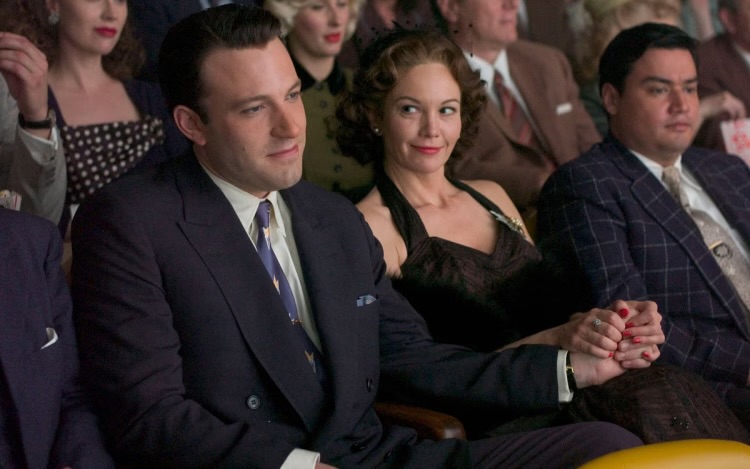
Flashback to a bustling restaurant, Ciro’s in Los Angeles, a young Reeves and his friend eating and drinking. It’s a swinging scene, Rita Hayworth arrives to dine, but Reeves’ eyes lock with Toni Mannix, played by a sensational Diane Lane, the wife of MGM boss Eddie Mannix. Mannix’s nickname was “the fixer” — he was notorious for making stars problems go away, and an expert at concealing certain things in stars’ personal lives they may not have wanted the public to see or know. Mannix had power and a sense of authority.

This authority, however, did not necessarily extend to Toni, who enjoyed an open, arrangement with her husband — in a later scene the husband and wife dine together with their significant others (Toni with Reeves, Mannix with his young Asian beauty). Reeves tells her he was in Gone With the Wind, but he’s “currently auditioning for numerous roles.” “There’s a lot of wanting. A lot of waiting. That’s your life” Reeves informs Maddox. He clings to his part in Gone with the Wind as a sign he is relevant and deserves more attention as an actor. Fixating on his past achievement is Reeves’ crutch, something that he brings up numerous times throughout the film, especially when he’s in a moment of crisis. It functions as a badge prestige that Reeves grips as a sign he’s made it in Hollywood.

Reeves relationship with Toni certainly enhances his career. In many ways, the relationship between Reeves and Toni mirrors Sunset Boulevard’s Gloria Swanson and Joe Gillis, albeit with a smaller age gap and less of the intense drama. Toni is not as unstable and reclusive silent movies star, but in Hollywoodland,her devotion to Reeves is undoubtedly one-sided. Toni buys him a house, finances his whims, and lavishes gifts upon him. One of these gifts being a gun. Toni is smart and knows the business, suggesting he stick to Superman despite his vocal disdain for the role. Reeves talks about a ‘job being a job’ but seems reluctant to pursue this ‘kids show’ that will make him a star. In one scene, he burns his Superman suit, something that Reeves would do to mark the completion of every season. We see this mirrored in a scene with Simo’s son, in which the distraught child burns his own Superman suit on his mother’s sofa after learning of the actor’s death. “You begged me for that suit,” a perplexed Simo tells his son, not realizing how much his child has been affected by the newspaper headlines screaming “SUICIDE” of his hero. 

What Hollywoodland does so well is the movie encourages the viewer to look beyond Reeves as the dashing Superman and see him as a charming albeit self-centered man hungry for fame and accolades. Reeves is not likeable at times, and neither is Simo, which is what makes him the perfect man to investigate the case. Both men are searching for something, but they are not sure what that is, or if it’s obtainable. Reeves has Toni, who’s married, yes, and older, but the open marriage and her riches gift Reeves all the material possessions he could ever want or desire, and he’s a hit on a popular television show. But the show’s cancellation, the passing of time, and ego can be a triple combination for a man once in his prime. His proposal to Lenore Lemmon, a younger woman who he meets during a two-week stay in New York, is because “she makes me feel young.” Reeves is a man determined to stay relevant. In Hollywoodland, we could even say Reeves’ callous dumping of Reeves lead to one interpretation of his untimely demise. 

Hollywoodland depicts three versions of Reeves’ death through Simo’s eyes, each prefixed with Reeves playing the guitar in his home and singing the song Aquellos Ojos Verdes, or Green Eyes. Each account bookmarks a significant point in Simo’s investigation. The P.I. functions as a cypher enabling the filmmakers both space and the platform to address the perplexities, theories, and negligence surrounding Reeves death as they interrogate the question: was Reeves murdered or was it, as the Police report stated, suicide?

In the first scenario, Reeves is arguing with Lemmon, who he’s due to marry—Lemmon says—in several days. Lemmon carelessly waves a gun, gesticulating around their bedroom until a trigger, accidentally, goes off. In the second, a contented Reeves goes upstairs only to find himself apprehended and shot when an anonymous intruder enters the bedroom, catching Reeves off-guard. The third and final version occurs near the films ending with Reeves goes upstairs, sits on his bed, and stairs into the distance. He looks bereft; the once-mighty Man of Steel now back to where he started, only this time older, and with a partner whose younger friends have no time or interest in him. He has lost the security of Toni’s money, and while comfortable, he does not know what’s next. The lack of fame and glory is his kryptonite, and Simo’s eyes, staring at his window, we see the bright of a gun’s explosion.

Some may say that Hollywoodland confirmed the suicide ruling of Reeves death, for other viewers it may provoke further questions about the final moments of the actor’s life. Nobody will ever know what occurred on that fateful evening, and Hollywoodland smartly conveys this in its final scene. Fundamentally, the film is a testimony and tribute to a complicated man who died tragically, and who was more than a moment in television and Hollywood history.  

This essay was written for CrimeReads and first published 7 January 2021.
Film Intro: “Serial Mom” [MAC Birmingham, 31/08/24)

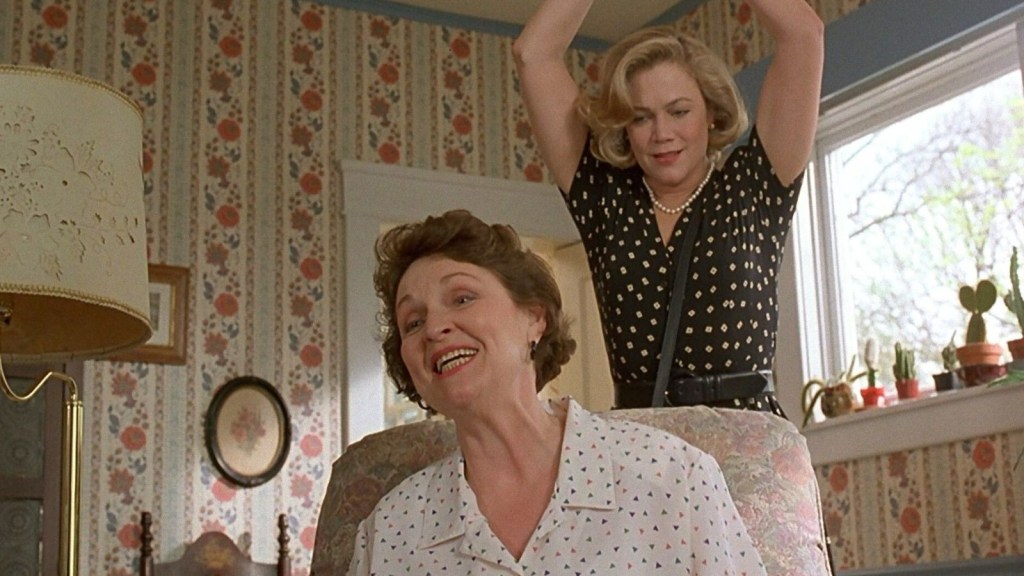
In her July 2024 essay for CrimeReads, Julia Sirmons notes that “Serial Mom opens with title cards that mimic the typical true crime disclaimers: the film was based on interviews and witness testimony. And then,” she says, “there’s the kicker: “Some of the innocent characters’ names have been changed in the interest of a larger truth.’” As Sirmons notes, the quotation marks work in two ways: to protect crime fiction from liability, and to make a case for its own cultural legitimacy. “Waters,” she continues, “mimicking this, makes his satire reveal larger truths about American values and obsessions.”

To say a filmmaker like John Waters relishes skewering various facets of human nature and family values—including obsessions with true crime and celebrity culture—would be an understatement, and we, his rapt audience, take perverse pleasure in his pride. This is perhaps why 1994’s Serial Mom, Waters’ satirical black comedy about a seemingly mild-mannered housewife with a murderous disposition, was the perfect vehicle for the provocateur affectionately dubbed the “Pope of Trash”, an auteur who takes every opportunity to expose the seedier and more perverted side of suburbia. Serial Mom is one of Waters’ best, yet it is seldom screened or broadcast; reviews were mixed at the time of release, and the film tanked at the box office (it grossed nearly $8 million). Yet Waters’ scathing comedic satire has since become a much-loved cult classic and favourite.

Serial Mom stars Kathleen Turner as Beverly Sutphin, alongside a supporting cast of Sam Waterston, Ricki Lake, and a pre-Scream Matthew Lillard as her on-screen family. The many cameos include heiress/fugitive Patty Hearst, the late actress and author Suzanne Somers—who appears as a fan hoping to portray her “feminist heroine” in a made-for-TV movie about Beverly’s life—alongside comedian/legend Joan Rivers, former porn star and actress Traci Lords, and Warhol Factory member Brigid Berlin. Both Lake and Lords are Waters darlings, having appeared in Cry Baby four years earlier.

On the surface Beverly is a polite and unassuming upper-middle-class housewife to her dentist husband and a doting mother to their teenage children, living in Towson, Maryland. (Waters likes to keep things loyal to his native Baltimore). However, as we know—whether via David Lynch’s Blue Velvet or the television series Desperate Housewives—never to be fooled by the niceties of suburbia and a white picket fence. Behind the perky demeanour, pie baking, and pinafores, Beverly is a phone-pranking, gore-loving, cold-blooded serial killer with a simple code: if you annoy her, she will murder you—and she will murder in broad daylight, on the high school grounds, or in the men’s bathroom of the local mall— for “perceived crimes against polite society,” whether that is wearing white after Labor Day or failing to rewind a rented VHS tape. Yet Beverly has no qualms in dirtying things closer to home, whether that be a neighbour who stole her parking space, a teacher criticising her son’s interest in horror films, or a love rat standing her daughter up for a date. Some might say she is a protective mother with her family’s interests at heart and no time for criticism of her children, qualities of a good and nurturing matriarch but executed (quite literally) in a manner that says otherwise. However, unlike most of the mothers in the MAC’s series of Motherhood on Screen, Beverly is the only one with serial killer paraphernalia under her mattress.

It is curious to think that Meryl Streep, Kathy Bates, Glenn Close, and even international treasure Julie Andrews had been considered for the role, but Turner is fantastic as Beverly, putting everything and then some into her portrayal. For the film’s inspiration, Waters’ drew on work by Doris Wishman, Otto Preminger, William Castle, and Herschell Gordon Lewis, and rather than conceal these influences, we see examples of their films playing on television sets at various points during Serial Mom. However, the audio we hear of Ted Bundy’s voice is not that of the jailed convicted murderer but the voice of Waters himself.

Having made his name in the early 1970s with transgressive cult films that riff on comedy and surrealism Waters has given us Multiple Maniacs (1970), Pink Flamingos (1972), Female Trouble (1974), Hairspray (1988) (which was later adapted into a hit Broadway musical and a 2007 musical film), as well as Polyester (1981), Cry-Baby (1990), Serial Mom (1994), Pecker (1998), and Cecil B. Demented (2000). Not one for subtlety, Waters never does things by half. Yet his work has such style and humour, and Serial Mom remains as riotous, fresh, and funny as it was thirty years ago. It’s impossible not to titter when Turner is pranking Waters’ long-time collaborator, Mink Stole, with the most over-the-top, preposterous insults, yielding—much like the rest of Serial Mom—some laugh out loud hilarious moments.

In her article, Sirmon noted the comparisons between the fictional Beverly and the factual Betty Broderick, a wealthy suburban mother who killed her ex-husband and his new wife after an acrimonious divorce in a murder case that gripped America’s fascination. “If Broderick,” Sirmon writes, “a picture-perfect Super Mom, could suddenly “snap” and become a killer, what were other seemingly-contended housewives capable of?”

Film Intro: “The Idiots” [MAC Birmingham 10/09/23]

Lars von Trier’s 1998 pitch-black comedy-drama The Idiots, I won’t deny, is a tricky one to introduce and probably the most volatile of LvT’s films. It was the first to be made in total accordance with the Dogme 95 Manifesto (as established in previous weeks, Breaking the Waves was the first film he completed following the manifesto’s conception). The Idiots, often called Dogme # 2, is also the second in LvT’s Golden Heart Trilogy, succeeding Breaking the Waves and preceding Dancer in the Dark.

While Luis Buñuel’s 1972 Discreet Charm of the Bourgeois was about disrupting a well-to-do couple’s lavish dinner party in Surrealist style, it was funny rather than offensive. In Kristoffer Borgli’s 2022 film Sick of Myself,  a young woman called Signe (played brilliantly by Kristine Kujath Thorp) starts taking illegal drugs to make herself ill in a quest for celebrity. Sick of Myself was often rip-roaringly funny for showcasing the inherent narcissism prevalent in the social media age, and while it was called shallow in parts, human beings are frequently shallow people who thrive on attention, which made Signe’s narcissist devices to gain fame so funny. We could say that The Idiots paved the way for such a nihilistic satire, albeit in a very confrontational, controversial, and extreme way.

In every Lars von Trier film, he asks us to confront something deeply uncomfortable about the human condition: in Antichrist, it is grief and violence. In Breaking the Waves, the limits of faith and love. While it is impossible to shy away from The Idiots’ incredibly provocative and offensive subject matter and brazen bad taste, von Trier’s iconoclasm and taboo-shattering work still exposes sociological behaviour codes, ideas of normalcy, and conditioned emotional responses.

As divisive now as when it was released in 1998, The Idiots was nominated for a prestigious Palme d’Or at the Cannes Film Festival AND booed and criticised for its subject matter. In brief terms, the film is about a group of able-bodied people who, in seeking their ‘Inner Idiots,’ take on attributes of disabled people in public. 

Filmed in four days and with a largely non-narrative and improved script, the film begins with Karen (Bodil Jørgensen), a polite, shy, quiet, severely unhappy woman – with a delicacy not unlike Emily Watson as Bess in Breaking the Waves – who is eating lunch in a restaurant alongside a group of disabled adults. While the other diners look on, aghast at their behaviour, Karen’s kindness and curiosity lead one of the group, Stoffer (Jens Albinus), to take a shine to her. Karen, who, through her own desires and actions – they don’t force her – goes back to their residence, where she learns the truth: this is all an act, Stoffer is house-sitting for his rich Uncle while the house is on the market, and the group take turns to (disgracefully) act out various forms of disability in public to, as they claim, free themselves from the trappings of their day to day lives. 

Stoffer is cultish in his self-appointed leadership role, and while the others leave their inner Idiot at the commune’s door, Stoffer believes they should take it home to their families and let it into their personal lives. This is one example where the group is not as unified as first thought, and one of the ways they start to splinter as a unit. Another occurs when a commune member invites a group of individuals with Down’s syndrome to tea at the house. Stoffer storms off while the others display genuine tenderness, compassion, and kindness towards these strangers. At that moment, it appears Stoffer has become one of the very individuals in the restaurant he was attempting to rail against. 

The film does have one of two genuinely funny moments not hinged on their unacceptable behaviour. When the group visits a factory, and the foreman gets Stoffer to drive the van home, it’s funny because seeing someone drive a vehicle non-fatally into bushes is always funny. There are also jaw-dropping moments of graphic nudity and sex. But at the same time, putting these moments of hilarity into a film such as this implies von Trier is pointing to the audience by saying, “Yes, these people are deplorable, their actions are abhorrent, yet you are still finding moments of humour.” 

But underneath it all, there is a tragedy, as many of these people have been broken by various situations in their personal lives and found freedom and community in this group of people’s unacceptable actions. Karen’s is by far the most interesting story – a broken woman in a deep pit of grief who has found the family and affection she craves and a form of therapy through the group. This culminates in a powerful final scene after Karen returns to the home she originally fled, revealing both the grief that sent her running, and the healing she achieved in this community.

Film Intro: “Breaking the Waves” [MAC Birmingham 01/09/2023]

Breaking The Waves

In 1995, the controversial filmmaker Lars von Trier founded the Dogme 95 filmmaking movement with fellow Danish director Thomas Vinterberg. Dogme 95 was about creating films based on the traditional values of story, acting, and theme while excluding the use of elaborate special effects or technology – essentially a way for filmmakers to reclaim their power from the studios. While Breaking the Waves was the first film von Trier made after Dogme 95 and was inspired by its code, it wasn’t the first made in it’s vision (that title went to 1998’s The Idiots) because sets were built, music was added in post op, and computer graphics were used for the chapters title cards. However Breaking the Waves was shot entirely on Super35mm handheld camera which provides its naturalistic element, and is divided into chapters and an epilogue, with each chapter card filmed with a motionless camera but featuring movement in the panorama. In the original released theatrical cut, the epilogue featured David Bowie’s “Life on Mars,” later replaced by Elton John’s “Your Song” on early home video releases. The more recent Criterion edition restores the Bowie song.

Breaking the Waves was the first of von Trier’s films to feature a female protagonist (his earlier works have been said to “typically feature a disillusioned male idealist brought down by a deceitful woman”), and he would continue to write female leads in subsequent works. Yet von Trier’s female protagonists are often mired in controversy. Bess from Breaking the Waves is one such example.

Bess (played by the extraordinary Emily Watson) is a fragile young woman living in a religious and isolated Scottish town who has a history of mental health issues following her brother’s death. A woman of intense faith who converses with God, Bess is very pure, somewhat childlike, and fundamentally a good person – she is even described as being “good” in the film, and sometimes being too good a person has consequences. 

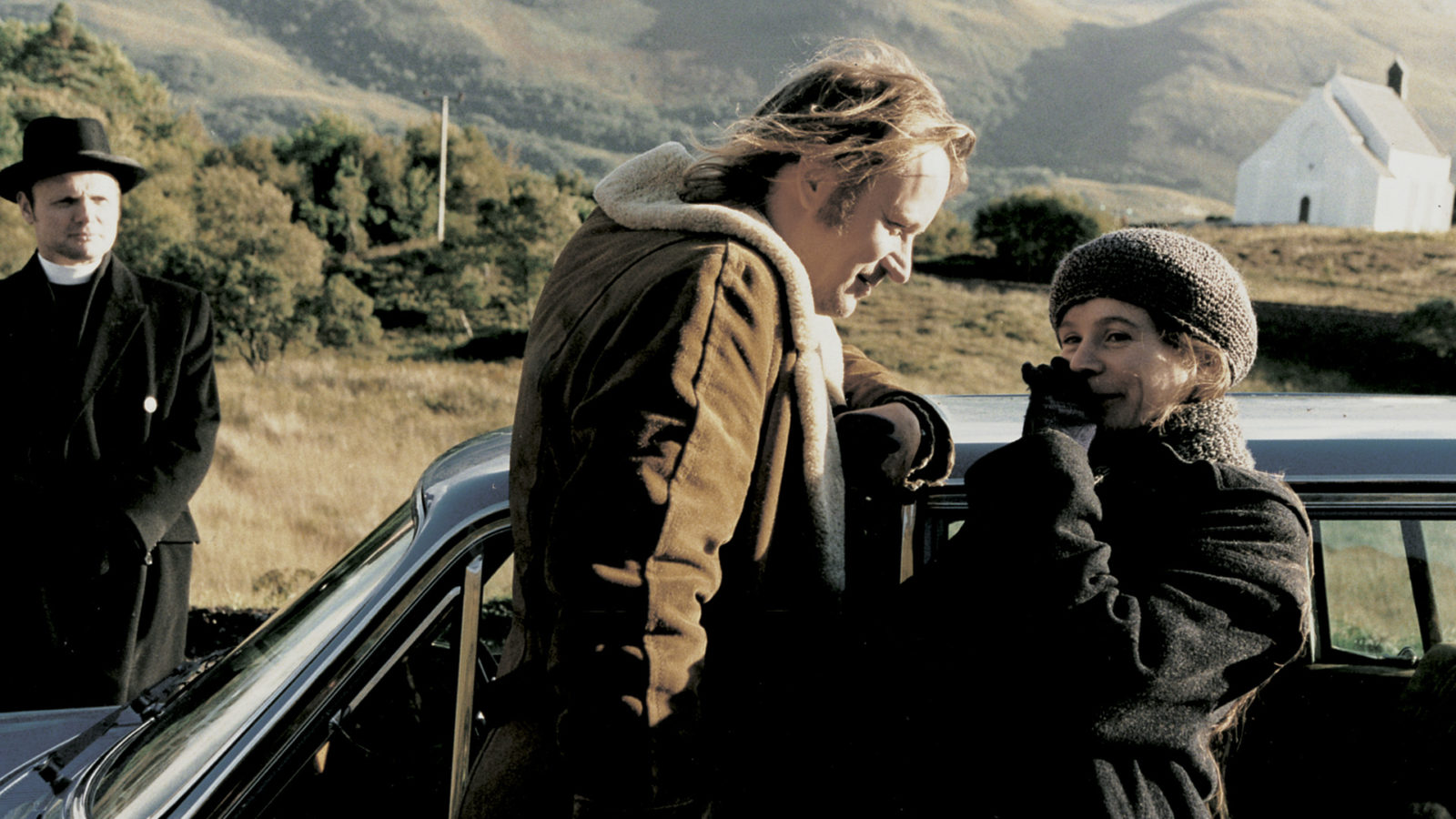
Bess’ image and fragility are why her marriage to Jan (Stellan Skarsgård), a trawler man working on a rig and not originally from the Island, is met with some disapproval from the local community. But Bess is besotted with Jan – he is her sexual awakening, she’s very clingy with him, and she finds it unbearable how his work takes him away from her for long periods of time. She says she “loves him too much.” 

Early in their marriage, and early in the film, Jan becomes paralysed following an accident at work. No longer able to physically satisfy his wife, Jan encourages Bess to sleep with other men and tell him about her adventures. When Bess relents to Jan’s voyeuristic desires, and Jan shows signs of improvement, she starts to believe her husband’s recovery is contingent on her actions. In convincing herself she has the power to heal, Bess essentially martyrs herself out of overwhelming love and devotion to her husband.

Some critics viewed Bess as a self-sacrificing submissive heroine and misogynist cliché, while von Trier’s themes of female sexual perversity, phallocentrism, and martyrdom – which would be continued in subsequent works – were also criticised. Yet what makes Breaking the Waves such an enthrallingly beautiful (and tough in parts, that’s undeniable) viewing experience is due to Watson, who is a force as Bess – an Academy Award nominated force – in what was, stunningly, her feature film debut. Watson is a beautifully physical actor (she does something similar in Anand Tucker’s Hilary and Jackie in her role of Jackie du Pré), and you see Bess’ physicality alter throughout the film depending on who she is with at any given time. Watson was actually expelled from the London College of Philosophy and Economic Science for taking on this role due to its graphic themes and nudity (the very reasons Helena Bonham Carter dropped out of the production), which is ironic given how Bess is ostracised by society in the film.

Huge praise must also be given to the late Katrin Cartlidge as Dorothy or the affectionately nicknamed “Dodo”, who plays Bess’ sister-in-law. A frequent collaborator of Mike Leigh who was due to play Patricia Clarkson’s roll in Dogville, the immensely talented Cartlidge tragically passed away in 2002 at the age of 41 due owing to complications from pneumonia and septicaemia (stemming from a pheochromocytoma). Dodo is Bess’ closest companion, a nurse in the hospital who is caring for Jan, and she is Bess’s pragmatic voice of reason.

Von Trier has often said he is an atheist, and wanted to make a naturalistic film that was also religious – Bess even compares herself to Mary Magdeleine at one point – but for it to be a film without any miracles. Breaking the Waves is often described as magical realism, and there is certainly a fantastical, almost spiritual, element, built-in. Undeniably, there are some gorgeous moments of metaphysical magic. 

Essentially, Breaking the Waves is a beautiful, shattering, film about love, devotion, the power and limits of faith, and the investment of belief to help the people you love.