Film Intro: “The Idiots” [MAC Birmingham 10/09/23]

Lars von Trier’s 1998 pitch-black comedy-drama The Idiots, I won’t deny, is a tricky one to introduce and probably the most volatile of LvT’s films. It was the first to be made in total accordance with the Dogme 95 Manifesto (as established in previous weeks, Breaking the Waves was the first film he completed following the manifesto’s conception). The Idiots, often called Dogme # 2, is also the second in LvT’s Golden Heart Trilogy, succeeding Breaking the Waves and preceding Dancer in the Dark.

While Luis Buñuel’s 1972 Discreet Charm of the Bourgeois was about disrupting a well-to-do couple’s lavish dinner party in Surrealist style, it was funny rather than offensive. In Kristoffer Borgli’s 2022 film Sick of Myself,  a young woman called Signe (played brilliantly by Kristine Kujath Thorp) starts taking illegal drugs to make herself ill in a quest for celebrity. Sick of Myself was often rip-roaringly funny for showcasing the inherent narcissism prevalent in the social media age, and while it was called shallow in parts, human beings are frequently shallow people who thrive on attention, which made Signe’s narcissist devices to gain fame so funny. We could say that The Idiots paved the way for such a nihilistic satire, albeit in a very confrontational, controversial, and extreme way.

In every Lars von Trier film, he asks us to confront something deeply uncomfortable about the human condition: in Antichrist, it is grief and violence. In Breaking the Waves, the limits of faith and love. While it is impossible to shy away from The Idiots’ incredibly provocative and offensive subject matter and brazen bad taste, von Trier’s iconoclasm and taboo-shattering work still exposes sociological behaviour codes, ideas of normalcy, and conditioned emotional responses.

As divisive now as when it was released in 1998, The Idiots was nominated for a prestigious Palme d’Or at the Cannes Film Festival AND booed and criticised for its subject matter. In brief terms, the film is about a group of able-bodied people who, in seeking their ‘Inner Idiots,’ take on attributes of disabled people in public. 

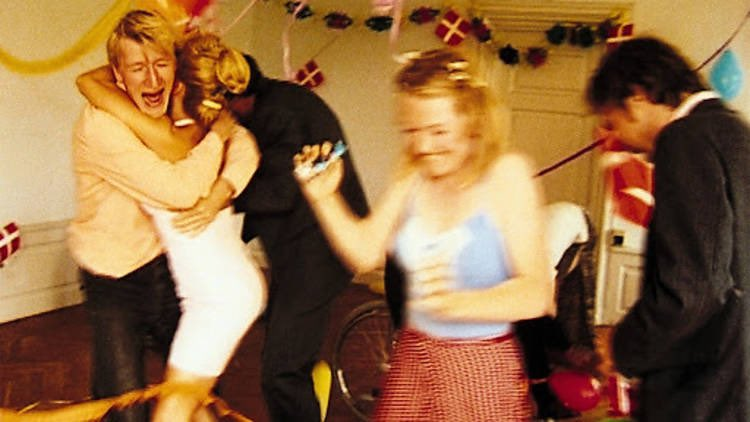
Filmed in four days and with a largely non-narrative and improved script, the film begins with Karen (Bodil Jørgensen), a polite, shy, quiet, severely unhappy woman – with a delicacy not unlike Emily Watson as Bess in Breaking the Waves – who is eating lunch in a restaurant alongside a group of disabled adults. While the other diners look on, aghast at their behaviour, Karen’s kindness and curiosity lead one of the group, Stoffer (Jens Albinus), to take a shine to her. Karen, who, through her own desires and actions – they don’t force her – goes back to their residence, where she learns the truth: this is all an act, Stoffer is house-sitting for his rich Uncle while the house is on the market, and the group take turns to (disgracefully) act out various forms of disability in public to, as they claim, free themselves from the trappings of their day to day lives. 

Stoffer is cultish in his self-appointed leadership role, and while the others leave their inner Idiot at the commune’s door, Stoffer believes they should take it home to their families and let it into their personal lives. This is one example where the group is not as unified as first thought, and one of the ways they start to splinter as a unit. Another occurs when a commune member invites a group of individuals with Down’s syndrome to tea at the house. Stoffer storms off while the others display genuine tenderness, compassion, and kindness towards these strangers. At that moment, it appears Stoffer has become one of the very individuals in the restaurant he was attempting to rail against. 

The film does have one of two genuinely funny moments not hinged on their unacceptable behaviour. When the group visits a factory, and the foreman gets Stoffer to drive the van home, it’s funny because seeing someone drive a vehicle non-fatally into bushes is always funny. There are also jaw-dropping moments of graphic nudity and sex. But at the same time, putting these moments of hilarity into a film such as this implies von Trier is pointing to the audience by saying, “Yes, these people are deplorable, their actions are abhorrent, yet you are still finding moments of humour.” 

But underneath it all, there is a tragedy, as many of these people have been broken by various situations in their personal lives and found freedom and community in this group of people’s unacceptable actions. Karen’s is by far the most interesting story – a broken woman in a deep pit of grief who has found the family and affection she craves and a form of therapy through the group. This culminates in a powerful final scene after Karen returns to the home she originally fled, revealing both the grief that sent her running, and the healing she achieved in this community.

Film Intro: “Breaking the Waves” [MAC Birmingham 01/09/2023]

Breaking The Waves

In 1995, the controversial filmmaker Lars von Trier founded the Dogme 95 filmmaking movement with fellow Danish director Thomas Vinterberg. Dogme 95 was about creating films based on the traditional values of story, acting, and theme while excluding the use of elaborate special effects or technology – essentially a way for filmmakers to reclaim their power from the studios. While Breaking the Waves was the first film von Trier made after Dogme 95 and was inspired by its code, it wasn’t the first made in it’s vision (that title went to 1998’s The Idiots) because sets were built, music was added in post op, and computer graphics were used for the chapters title cards. However Breaking the Waves was shot entirely on Super35mm handheld camera which provides its naturalistic element, and is divided into chapters and an epilogue, with each chapter card filmed with a motionless camera but featuring movement in the panorama. In the original released theatrical cut, the epilogue featured David Bowie’s “Life on Mars,” later replaced by Elton John’s “Your Song” on early home video releases. The more recent Criterion edition restores the Bowie song.

Breaking the Waves was the first of von Trier’s films to feature a female protagonist (his earlier works have been said to “typically feature a disillusioned male idealist brought down by a deceitful woman”), and he would continue to write female leads in subsequent works. Yet von Trier’s female protagonists are often mired in controversy. Bess from Breaking the Waves is one such example.

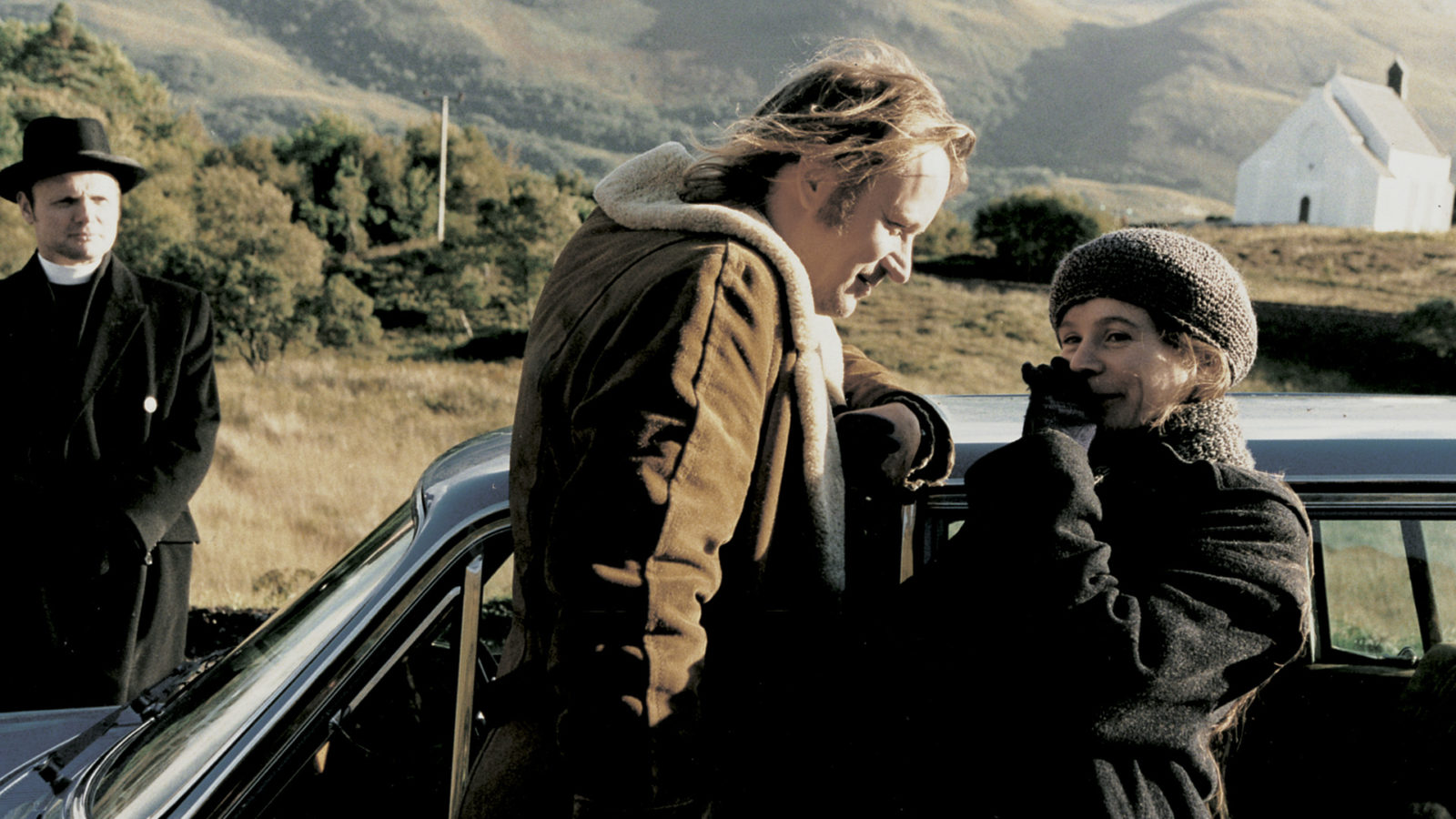
Bess (played by the extraordinary Emily Watson) is a fragile young woman living in a religious and isolated Scottish town who has a history of mental health issues following her brother’s death. A woman of intense faith who converses with God, Bess is very pure, somewhat childlike, and fundamentally a good person – she is even described as being “good” in the film, and sometimes being too good a person has consequences. 

Bess’ image and fragility are why her marriage to Jan (Stellan Skarsgård), a trawler man working on a rig and not originally from the Island, is met with some disapproval from the local community. But Bess is besotted with Jan – he is her sexual awakening, she’s very clingy with him, and she finds it unbearable how his work takes him away from her for long periods of time. She says she “loves him too much.” 

Early in their marriage, and early in the film, Jan becomes paralysed following an accident at work. No longer able to physically satisfy his wife, Jan encourages Bess to sleep with other men and tell him about her adventures. When Bess relents to Jan’s voyeuristic desires, and Jan shows signs of improvement, she starts to believe her husband’s recovery is contingent on her actions. In convincing herself she has the power to heal, Bess essentially martyrs herself out of overwhelming love and devotion to her husband.

Some critics viewed Bess as a self-sacrificing submissive heroine and misogynist cliché, while von Trier’s themes of female sexual perversity, phallocentrism, and martyrdom – which would be continued in subsequent works – were also criticised. Yet what makes Breaking the Waves such an enthrallingly beautiful (and tough in parts, that’s undeniable) viewing experience is due to Watson, who is a force as Bess – an Academy Award nominated force – in what was, stunningly, her feature film debut. Watson is a beautifully physical actor (she does something similar in Anand Tucker’s Hilary and Jackie in her role of Jackie du Pré), and you see Bess’ physicality alter throughout the film depending on who she is with at any given time. Watson was actually expelled from the London College of Philosophy and Economic Science for taking on this role due to its graphic themes and nudity (the very reasons Helena Bonham Carter dropped out of the production), which is ironic given how Bess is ostracised by society in the film.

Huge praise must also be given to the late Katrin Cartlidge as Dorothy or the affectionately nicknamed “Dodo”, who plays Bess’ sister-in-law. A frequent collaborator of Mike Leigh who was due to play Patricia Clarkson’s roll in Dogville, the immensely talented Cartlidge tragically passed away in 2002 at the age of 41 due owing to complications from pneumonia and septicaemia (stemming from a pheochromocytoma). Dodo is Bess’ closest companion, a nurse in the hospital who is caring for Jan, and she is Bess’s pragmatic voice of reason.

Von Trier has often said he is an atheist, and wanted to make a naturalistic film that was also religious – Bess even compares herself to Mary Magdeleine at one point – but for it to be a film without any miracles. Breaking the Waves is often described as magical realism, and there is certainly a fantastical, almost spiritual, element, built-in. Undeniably, there are some gorgeous moments of metaphysical magic. 

Essentially, Breaking the Waves is a beautiful, shattering, film about love, devotion, the power and limits of faith, and the investment of belief to help the people you love.

Magnum On Set: “American Graffiti”

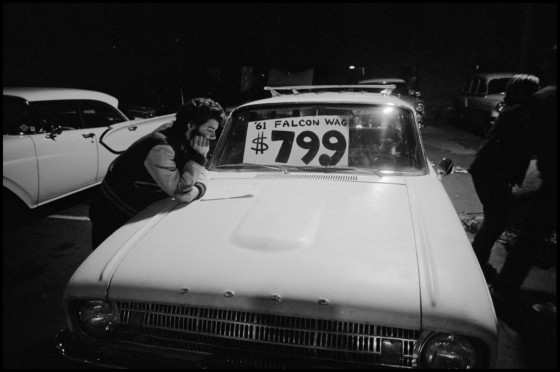
It’s George Lucas’ Birthday. In 2020 I wrote about my favourite Lucas film, American Graffiti, and Dennis Stock’s on-set photographs of the production for Magnum Photos: https://www.magnumphotos.com/arts-culture/cinema/magnum-on-set-american-graffiti/

Essay: Buñuel and the Surrealists

Fortunately, somewhere between chance and mystery lies imagination, the only thing that protects our freedom, despite the fact that people keep trying to reduce it or kill it off altogether – Luis Buñuel.

Whatever art form it takes, whether painting, fashion, sculpture, or film, Surrealism has always been about disruption and the disorder of convention.

When the writer, poet, and co-founder of Surrealism André Breton was young, he and his friend, the French poet Jacques Vaché, would walk in and out of films at the cinema. At the end of the day, both young men would mentally edit all the images they had seen both on screen and off, mentally piecing the pictures together to create a personally unique movie of their very own. The result was “the visual collage thus put together in their heads as if it were a single film.”

We may say a similar approach was taken with Un Chien Andalou, Spanish filmmaker Luis Buñuel’s 1929 collaboration with Salvador Dalí. Both men pooled together two dreams, one each had experienced: Buñuel divulged his dream in which he saw a cloud sliced the moon in half, “like a razor blade slicing through an eye,” while Dalí replied with his dream about a hand festooned with crawling ants. These have become the best known images of Un Chien Andalou, a free association short film written by Buñuel and Dalí that continues to endure because of its Surrealist associations, Freudian symbolism, and dream imagery. The opening scene sets the tone, signposting the viewer to let the unconscious navigate. As Antonin Artaud once said, “the eye is the locus of transmission of meaning from writer to audience.”

Buñuel and Dalí intended their audiences to view the film in the same way as their artwork: reactionary, whether visceral or emotional. More importantly, they wanted audiences to suspend belief, let the unconscious take charge. The sliced eye was a metaphor that “links inner and outer, subjective, and objective,” what author Fiona Bradley describes as a ‘glace sans tain’, or a mirror without silvering’. Suspend belief, go internally and let the subconscious take over. The sluiced eye would inspire the severed ear lying in the grass behind the white picket fence in the opening segment of David Lynch’s neo-noir psychosexual fantasia Blue Velvet (1986). Both films signal the entry point into the world about to be inhabited, much like Alice falling down the rabbit hole and entering Wonderland. 

Un Chien Andalou relied on the subversion of the real world rather than flight from it. Where other films of the time were more abstract, interested primarily in photographic effects and the manipulation of light and shadow, Buñuel and Dalí’s dissolved one easily recognizable image into another at high speed. At one point, the camera focuses on a hand swarming with ants. In quick succession, the image then dissolves into one of the armpit hair of a girl lying on a beach, the spines of a sea-urchin, and the head of another girl. In another sequence, the man caresses a girl’s breasts, which turn into her thighs while he is touching them. As once Buñuel once said:

The plot is the result of a conscious psychic automatism, and, to that extent, does not attempt to recount a dream, although it profits by a mechanism, analogous to that of dreams. The sources from which the film draws inspiration are those of poetry, freed from the ballast of reason and tradition. Its aim is to provoke in the spectator instinctive reactions of attraction and repulsion.

Buñuel’s intentions for Un Chien Andalou, like many of his films, was to disrupt the social order, especially to offend the intellectual bourgeois of his youth. He took this mentality into the premiere of the film, attended by elite members of Parisian society known as ‘le tout-Paris,’ in which he alleged he placed rocks in his pockets. If the event was a disaster, he would throw them. Fortunately for all, it was a success.

Buñuel continued this mission of offence and mischief in 1972’s The Discreet Charm of the Bourgeoisie. Co-written with the French novelist Jean-Claude Carrière, the film weaves several linked vignettes in which a party of middle class attendees attempt, unsuccessfully, to dine together, and the interruptions that ensue. While Un Chien Andalou was intended to shock the bourgeois, The Discreet Charm of the Bourgeoisie unpacks this section of society to reveal their entitlement, but also their fears. The film is a Surrealist comedy, and as the audience we are both in on the joke, and soon revealed to be part of the punchline, too.

Dinner parties are, society would have us believe, ordered affairs, but the Surrealists understood the absurdity of formal and stuffy dining. As children, we are conditioned ‘not to play with our food,’ yet food and Surrealism have a long history of play. In Daisies (1966), Czech filmmaker Věra Chytilová’s Surrealistic comedy about two young women revelling in strange pranks, a hilarious food fight ensues. One artist deeply involved in the social disruption of food was the Swiss sculptor Meret Oppenheim. In her defining book about women artists and Surrealism, Women Artists and the Surrealist Movement, Whitney Chadwick writes that Oppenheim’s “youth and beauty, her free spirit and uninhibited behaviour, her precarious walks on the ledges of high buildings, and the “surrealist” food she concocted from marzipan in her studio, all contributed to the creation of an image of the Surrealist woman as beautiful, independent, and creative.” At the 1959 International Surrealist Exposition, Oppenheim presented Le Festin or ‘Cannibal Feast,’ a live art installation where a nude female model was used as a table to present a meal to attendees and partygoers. The photographer William Klein captured the image, which is more glamorous than gluttonous, and more gorgeous than grotesque.

Oppenheim was a sculptor with a knack for inverting the domestic. She covered a cup and saucer in fur and placed a trussed-up pair of virginal white shoes on a platter in the manner of a spatchcock chicken. Buñuel had previously played with dining in The Exterminating Angel (1962), a feature in which guests who have attended a lavish dinner party find themselves unable to leave following the room after their meal, resulting in all manner of chaos. Chaos is an element of L’Age d’Or, where Buñuel pushes the sexual proclivities of society, religion, and hypocrisy surrounding sex in high society. Once again co-written with Dalí, and cited as one of the first French sound films, in the film’s programme notes Dalí wrote that the idea ‘was to present the pure straight line of the conduct of one who pursued love in spite of the ignoble and patriotic ideals and other miserable mechanisms of reality.’

L’Age d’Or could be perceived as a Surrealist tale of desire between Gaston Modot’s unnamed man and his lady love Lya Lys, of the Amour Fou or ‘Mad Love’ that Breton talked about in his 1928 novel Nadja. The lovers are surrounded by the restrictions and constantly sneaking away to free themselves of these trappings and constraints, but everywhere they go, they are reprimanded for disturbing the proceedings.

The film begins like a nature documentary about scorpions, a veiled metaphor for aggression and torture while involving the Surrealist’s fascination with entomology, before continuing as a series of vignettes in which the couple’s romance is continually interrupted by everyone and anyone in their path, notably their family, society, and the church. In an early scene, a begraddgled man (one of a group of bandits led by the Surrealist artist Max Ernst) encounters a group of chanting Bishops (called the Majorcans or Mallorcans) sitting on a pile of rocks.

We later see the Bishops reduced to their skeletal remains, and witness a scuffle during the blessing of a Holy relic (what appears to be a concrete square). The spectacle, like most of L’Age d’Or, is as disruptive and darkly comic as it is blasphemous. 

The farcical nature of this scene feeds into both Buñuel and Surrealist artists’ perceptions of religion. There is a lovely anecdote about the artist Leonor Fini arriving at one of the Paris cafés where the Surrealist group held regular meetings wearing pink silk cardinal’s stockings (items she had purchased from a religious vestment shop in Rome’s Piazza al Minerva). Breton was obviously thrilled at Fini’s anti-clericalism and display of cross-dressing. Yet this reaction was not her intention. Fini — a painter, set designer, illustrator, author, and costume designer who never wanted to be labelled a Surrealist despite her continued association — never wore the outfit with Breton in mind; her reason for wearing the stockings was much simpler: she liked the colour. She loved the erotic frisson experienced while wearing these stockings. She often wore scarlet cardinal robes for the same reason, and, as we know, she had been experimenting with clothing since childhood. Fini recounted this tale to the art scholar Chadwick in the 1980s, saying “I loved the sacrilegious nature of dressing as a priest who would never know a woman’s body.”

The note of pleasure ties into the sexual themes of L’Age d’Or. For example, fingers are frequently seen bandaged, but, as author Robert Short notes in his book ‘The Age of Gold: Surrealist Cinema’, that ‘fingers are bandaged because “bander” also means “to feel randy”. The girl’s ring finger bandaged alternates with the same unbandaged: horniness with detumescence.’ Self-pleasure, and pleasure, are evident throughout the film. In one scene, when her lover is called to a telephone call, the woman fellates the big toe of a statue until he returns in a bid to appease her lust.

The final vignette of L’Age d’Or doesn’t feature the lovers, but centres on The 120 Days of Sodom, the Marquis de Sade’s notorious pornographic and erotic 1785 novel about four libertines in search of the ultimate sexual gratification. Retreating to an inaccessible castle in Gemany for four months and locking themselves away with their accomplices and victims, four madams and 36 male and female teenagers, the orgies soon give way to abuse, torture, and death. In many ways  L’Age d’Or, especially this final scene, can be viewed as a precursor — or prequel of sorts — to Pier Paolo Pasolini’s infamous 1975 interpretation of the book, Salò, or the 120 Days of Sodom. Buñuel is not necessarily as graphic in his depictions, but he hints, and by continuing to push social and sexual boundaries, he concludes L’Age d’Or open to interpretation. This is affecting, and allows the viewer to chew on what has occurred, or what they believe has occurred, while leaving room for others to push the parameters further.Despite the controversial subject matter, Buñuel hoped L’Age d’Or would open to commercial audiences at the cinema on the Champs Elysées. Still, much to his chagrin, the film’s public premiere was at the smaller artistic Studio 28, with the Surrealists’ private screening at the Cinema du Panthéon. This downscaling of the venue, plus the film’s themes, saw the picture banned after six days of public viewing. Only three months earlier, in July 1930, Buñuel had told a Spanish journalist that he ‘wanted a moral scandal, that will consist in revolutionising the bad habits of a society in open conflict with nature’. It appears he had got his wish.

* This piece originally appeared in Radiance Films Dirty Arthouse Vol 2 (21 August 2023). Please click the link to buy.
Review: “Love Lies Bleeding”

In a recent interview with Indiewire, the British director and screenwriter Rose Glass said: “Just speaking for myself, anyone who tries to kid themselves that sex and violence aren’t some of cinema’s most important cornerstones is wrong. There is something exciting about living vicariously through these sorts of stories, which speaks to something more primal or shameful in all of us.” 

Sex and violence are the cornerstones of Glass’s Love Lies Bleeding, the much-awaited follow-up to her BAFTA-nominated debut feature, Saint Maud (2019). A gun-toting neo-noir set in the worlds of professional bodybuilding and crime, Love Lies Bleeding is a transgressive queer love story-thriller set in small-town Americana. The always great Kristin Stewart is reserved gym manager Lou, who falls hard for the new girl in town, Jackie (Katy O’Brien), a bodybuilder with her sights on winning the state championships who starts working at Lou’s criminal father’s gun range (a fantastic Ed Harris as the bug-loving—and chomping—Lou Sr., a kingpin with a “skullet” hairdo of the actor’s own design). As Lou and Jackie’s relationship intensifies, they are pulled into the murky and violent goings-on of Lou’s family with some shocking, brutal, and gruesome results.

Glass has always been a visual director, and Love Lies Bleeding uses its late 80s setting to utilise neon colours, mullet haircuts, bad teeth, shades of red, and a pulsing electronic soundtrack complimented by Clint Mansell’s thumping score. Gritty and sleazy, with elements of She-Hulk and a cautionary tale of Roid Rage, Love Lies Bleeding is a darkly comic and propulsive thrill ride.

*A version of this review first appeared on ichoosebirmingham.com 2 May 2024. 

Film Intro: Beth B.’s “Salvation!’”(1987) [MAC Birmingham, 28/01/2024]

*The screening was cancelled due to tech problems, but here’s my intro*

Beth B. has been a vital figure of the New York underground scene since the late 1970s, with a body of film work including documentary, experimental, and narrative – and sometimes a combination of all three.
 
In a conversation with Interview Magazine last year, she said, 

‘filmmaking has always been about power and control, and confronting the oppression of the patriarch. It’s definitely from a female point of view, it’s about the female gaze, and that’s why most of my films have very powerful women.’ 

Beth B.’s breakthrough films, which include Black Box (1978), Vortex (1981), and The Offenders (1980) – all co-directed with her then-husband Scott B. – have been screened at such famed New York venues as Max’s Kansas City, CBGB’s, the New York Film Festival, and Film Forum, and have since been shown at – and acquired by – the Whitney Museum and MoMA. Her early work appeared in Celine Danhier’s 2009 documentary film Blank City, alongside work by Jim Jarmusch and Amos Poe, and more recently produced and directed 2019’s The War Is Never Over, a documentary about iconic performance artist and frequent collaborator Lydia Lunch. Speaking to Hyperallergic about Vortex’s status as the last new wave film made, she said: 

‘What I’m doing is still No Wave. It’s a rejection of what is, and it’s embracing what is not: what we don’t see, what we don’t hear. My mode is to really bring those things to the fore.’

Salvation!  – with the secondary title Have You Said Your Prayers Today? (1987) –  was Beth B.’s first solo feature (she has made two solo features) and features a distinctive soundtrack featuring Cabaret Voltaire, Arthur Baker, and New Order (who did the theme) – the sort of film you will find on cult or restoration strands of festival circuits or television in the small hours. 
 
In Beth B.’s glossy 80s parody of televangelism, unemployed, non-religious factory worker Jerome Stample (Viggo Mortensen) ropes in his sister-in-law (Dominique Davalos), to abduct and blackmail a sex-obsessed TV minister, Rev Randall (Stephen McHattie). Events take a bonkers turn when Randall meets Jerome’s religious wife, Rhonda (played by Exene Cervenka of the punk band X), and is immediately convinced she is an evangelical rock star in the making. 
 
Salvation! is wild, scathing, and oddly prophetic because it was made before – but released after – the real-life scandals of televangelists Jim Bakker and Jimmy Swaggart (Jim Bakker was portrayed by Andrew Garfield in Michael Showalter 2021’s The Eyes of Tammy Faye opposite Jessica Chastain as Tammy Faye Bakker).  

In her chat with Interview, Beth B. said,

‘In the eighties, when suddenly these fucking televangelists were taking over America, and nobody seemed to know it except the evangelists. I was like, “I’m going to do some investigating.” I went to Jerry Falwell’s church, the Super Conference, and I found myself so frightened that when he said, “Get down on your knees,” I got down on my knees. I was afraid someone was going to shoot me! Because I’m the enemy. So that film, Salvation! is based on that experience.’

Indeed, Salvation! is a crazy experience, made without apology, but there is a kernel of truth when you get beyond the madness that feels oddly unsettling and accurate. As Beth B. herself admits:

Salvation! is a wild film. I mean, just the pace of it. I watched it a few months ago. I hadn’t watched it in decades. I was like, “Wow, holy shit! How did I make this fucking wild film?” Because it’s really insane. It is. It’s also just so hilariously funny. Well, actually not funny, sadly, because it was so prescient that the same shit is still happening now. And worse.’

 With a career spanning forty-five-years and exploring themes and exploring themes surrounding transphobia, domestic violence, and religious overreach, Beth B. continues to make politically charged and provocative films. And she has no desire to stop.
 
As she said last year:

‘I just can’t stop. It’s like my addiction. It’s a really phenomenal way of charting my journey through life. My films are, in some ways, very autobiographical. Even though they are not about me, they usually have some intense questions that I’m trying to work out in my life that the films somehow evolve from. And half the time, I don’t even know that when I’m starting to make a film, I just know I have a burning desire.’ 

*Film introduction for at Midlands Arts Centre, Birmingham, January 28 2024

Film Intro: Juliet Bashore’s “Kamikaze Hearts” (1986) [MAC Birmingham, 13/01/24]

Juliet Bashore’s groundbreaking docu-fiction Kamikaze Hearts is very much a product of a very specific period of the late 80s – not only in content, but also cinematic and cultural legacy. Released just prior to the more marketable and popular New Queer Cinema of the 1990s, Kamikaze Hearts’s taboo subject matter (pornography, graphic sex, and drug use), not to mention unstable genre categorisation and potted release history, scuppered the film’s from achieving canon status. But a 2022 release from Kino Lorber and rounds on various festivals’ restoration circuits courtesy of such organisations as Cinema Rediscovered (also known as CineRedis) have brought the film a new audience – and deserving so, because it’s a film that should be seen by a wider audience. 
 
In Kamikaze HeartsSharon ‘Mitch’ Mitchell and Tigr Mennett navigate their relationship as two active participants in the adult entertainment industry while filming a porn parody of Bizet’s opera ‘Carmen’. The production is riddled with set backs and problems, and we see how the filming impacts the couple’s relationship alongside the manipulation, abuse, and the excesses of the underground porn world during the 1980s. 
 
Bashore conceived the idea for the 1986 American quasi-documentary film as a filmmaking student working as an assistant director on a documentary about the porn industry in San Francisco, which is where she met Tigr. Tigr was head over heels in love with Mitchell, and in Bashore’s words, Tigr’s ‘idea of doing this homage to this woman that she was in love with—just came together perfectly. And that’s how it started.’
 
While multiple elements of Kamikaze Hearts are genuine, the ‘Carmen’ parody and the leading couple’s arguments were scripted and storyboarded, which assists to blur the line between truth and reality. The film straddles a fine line between fact and fiction – its alternative title is ‘Fact or Fiction’ – and this remains a thorough line throughout the film. Plus, Mitchell never appears to be “off” and is constantly performing. At one point she says, ‘I get paid to wait around between shots. I don’t get paid to act. I do that all the time.’
 
Bashore spoke to ScreenSlate in 2022 about the film’s fluctuating perceptions, and it’s tease between documentary and fiction, saying, 
 

‘I’ve learned to describe it differently depending on who the audience is because, from the very beginning, it was totally misunderstood. And I finally just gave in and said, Okay, it’s a documentary. I mean, people wouldn’t understand that it wasn’t really a documentary. When it first got picked up on the festival circuit it was stuck in the documentary section, and there was nothing I could do. They insisted that it was a documentary. So, I’ve learned to describe it in a way that I think the audience is gonna be able to understand, but that’s transformed. The audience is so different now and, in a way, I’m not used to talking to an audience that totally gets the way in which it is a documentary and isn’t a documentary. That’s not confusing at all to audiences now.’

 
The initial critical response for Kamikaze Hearts was varied, but Bashore’s filmmaking was consistently lauded, and the film has achieved something of a reappraisal in recent years. Some of the positive reviews included Kevin Thomas for the Los Angeles Times, who praised Bashore for ‘wisely’ allowing individual viewers to decide which portions are true. Liz Galst of Boston’s Gay Community News called Kamikaze Hearts “amazingly powerful,” notably Mitch and Tigr’s relationship and how pornographic performers navigate the lines between fiction and reality and went on to herald Bashore for being “at the forefront of U.S. non-fiction filmmaking”. But even the less favourable reviews could not deny the indelible images and people who linger long after the closing credits role.
 
As Bashore told ScreenSlate, ‘my film is about the layers of fantasy that surround that. It’s not about the the pornographic image so much as it is [about] all the layers, this other kind of striptease that’s going on, this psychic striptease.’
 
Aside from being an time capsule of a very specific time and an insightful depiction of the porn industry, part of Kamikaze Heart’s enduring nature – aside from Bashore’s lens – is due to Sharon Mitchell, who is one of the most charismatic screen presences you’ll encounter: glamourous, uninhibited, charming, cosmopolitan, a woman in command of her power who knows how to use her power. Mitchell made approximately 1,000 pornographic films over a 20-year career, including 38 as a director, but in 1996 she quit drugs, became a certified addiction counsellor, and obtained a MA and a PhD from the Institute for Advanced Study of Human Sexuality. Now a credited sexologist, in 1998 Mitchell founded the adult industry’s first mass testing service, which served practically every working performer in the US for 15 years, testing over 1000 performers per month (before being shut down due to data leak in 2011). That’s a film in itself.

*Film introduction for at Midlands Arts Centre, Birmingham, January 13 2024.