Noirvember – Day 12 (Beat the Devil, 1953)

beat-the-devil-bogart-and-lollobrigida

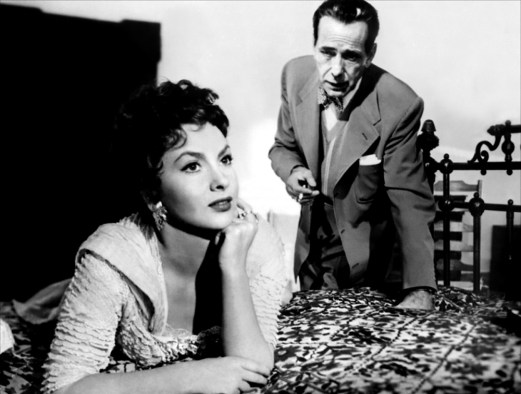
John Huston’s Beat the Devil is not easy to categorise. Part comedy, tongue-in-cheek, and rarely dramatic, Bogart described the film as “a sort of satire on the Maltese Falcon private detective,” while for John Huston it was “more a lark than a satirical story…It made no points about anything in particular, we just had a good time”. ‘We’ being the film’s star-studded cast including Humphrey Bogart, Gina Lollobrigida, Jennifer Jones and Peter Lorre.

While waiting in an Italian port to board a boat for Mombasa, a group of completely random people – two couples, a shifty-looking International trio and various other oddballs – connive to claim land rich in uranium. The plot is light, but the sartorial stakes are extremely high. It is impossible to deny that Lollobrigida oozes glamour as Maria (the wife of Bogart’s character), who never breaks a sweat and maintains effortless chic throughout the film. Whatever the situation she can be trusted to be seen in tight dresses, heels and perfectly un-smudged eyeliner. She also has some very funny moments, especially when she describes herself as an honorary Brit who maintains her subscription to Town & Country Magazine and has an afternoon tea ritual. She naturally falls for the English charms of Harry Chelm (played by the very British named Edward Underdone).

Although not quite as glamourous as Lollobrigida, Jones, in her oversized shirts and headscarves, adds to the continental allure. She raises a laugh when, in a cut-glass British accent, says she doesn’t trust the men because “not one of them looked at my legs”. Unfortunately for her, her hypochondriac husband constantly moans about “a chill on his liver”, has an unhealthy attachment to his hot water bottle, and (embodying the stereotypical Brit abroad) constantly moans about the unpalatable Italian food. You can understand why she falls for Bogart’s charms, dapperly dressed in a wonderful range of cravats and bow ties. Lorre too is rather chic as Julius O’Hara – “there are a lot of O’Haras in Chile” – who elegantly puffs away on a long white cigarette holder that matches his suit.

Convoluted, fast, funny and full of famous faces. There is little to not like about Beat The Devil. For serious noir watch The Maltese Falcon. If you like your noirs a little lighter, this can’t be beaten.


*This is a modified, slightly tidier version of a post that appeared on my old website (silverembers.com) on 6 October 2014. I don’t use that site anymore, so please continue to follow me here instead! Thank you.

Noirvember – Day 9 (Last night I dreamt…”, Part 2)

manderley

“The road to Manderley lay ahead. There was no moon. The sky above our heads was inky black. But the sky on the horizon was not dark at all. It was shot with crimson, like a splash of blood. And the ashes blew towards us with the salt wind from the sea”.

Noirvember – Day 6 (Faces)

homepage_eb20010513reviews08105130301ar

One of my first memories is of Humphrey Bogart’s face. I’ve already spoken about this in one of my TCMFF posts, but my Dad’s wardrobe is plastered in black and white postcards and film stills of Bogart, Lauren Bacall and James Dean. I grew up with the assumption that every father did this, and that everybody knew these faces, these voices, these films. I was raised with the assumption that every child knew of The Maltese Falcon, and that every parent paid homage to Old Hollywood. I may not have studied film long-term, but I had the best education: my Film Noir schooling began at home.

Noirvember – Day 3 (Black Angel, 1946)

black-angel-001

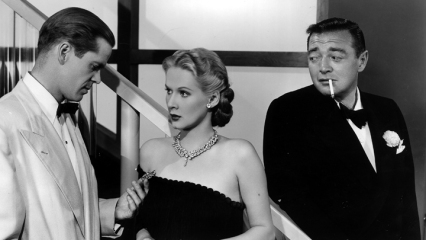
In an apartment dripping with indulgence – crystal chandeliers, fur rugs, jewels and perfectly lined-up ornate perfume bottles – lies the dead body of singer Mavis Marlowe (Constance Dowling). An unfired gun lies nearby and an expensive broach has been purloined by the murder. Three men visited (or attempted to visit) the singer in her double monogrammed apartment that night: her alcoholic ex-husband/composer and pianist Martin Blair (Dan Duryea) who is determined to win her back, shifty nightclub owner Marko (Peter Lorre) and lover Kirk Bennett.

Blame instantly falls on Bennett, caught fleeing the scene moments after Marlowe’s death, killing the chanteuse before she could divulge their affair to his wife Catherine (June Vincent) in all of its scandalous glory  The Police are convinced that they have found their man – Bennet’s fingerprints are all over Miss Marlowe’s gun – yet Catherine is determined that her husband is innocent. Blair has an alibi, his drunken binge that evening ended with him locked into his apartment by his building’s clerk, which only leaves Marko. Posing as a musical act, ex-singer Catherine and Blair become regulars at Marko’s club, earning his trust and closing in on the safe, which may or may not, hold the only evidence that will spare Bennett’s life.

Lorre does not have to do much in Black Angel, a film based on the work of Cornell Woolrich, yet it is impossible to take your eyes off him when he is on screen. His character is far from wholesome yet there is likeability to him – who can resist those hang-dog eyes? He is perfectly cast as the nightclub owner whose hands are far from clean. Duryea makes a convincing drunk (no-one intoxication quite like Duryea), which is frequently heightened by flashbacks and hallucinations, the unsteady camera-work accurately conveying the nausea and queasy feeling that is common of imbibing too much strong alcohol.

There is no denying that the women in the film are superb: Dowling is on wonderfully bitchy form as the demanding Marlowe, bossing her assistant and ruling her narcissistic apartment like a true diva. Yet it is Vincent who the film belongs, her transformation from housewife in dowdy clothes (if that is even possible in a film noir) to stunning lounge singer with eyes as glittering as the missing broach. She could have played the role as a frantic, desperate wife, yet she is composed, in control and more than capable when pitted against Lorre.

Black Angel may be lesser known when viewed against Lorre’s formidable body of work, yet it is perfectly indulgent film noir.


*This is a modified, slightly tidier version of a post that appeared on my old website (silverembers.com) on 20 September 2014. I don’t use that site anymore, so please continue to follow me here instead! Thank you.

Noirvember – Day 2 (Fur Envy)

joan-crawford-mildred-pierce

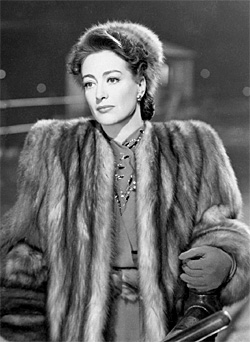
Joan Crawford: Fur Goals

The time has come to dig out my winter coat. It’s a shortish, greeny-blue, faux-fur number and I have had it for five years. When it is cold I want to sleep wearing it, and I hate taking it off once indoors. It becomes second skin from November until March. Winter is a sartorially fun season – lots of layering, fabrics, accessories and jewels – and it’s easier to up the glamour stakes. My rules are: the fluffier, bigger, warmer and cosier the item the happier I feel. I love the Film Noir Femmes who enter a room dripping in fur and pearls and hats and carrying a muff (no sniggering at the back). Luxuriant, indulgent, decadent. In my head I resemble Joan Crawford in Mildred Pierce, but in reality I’m Jane Lane.